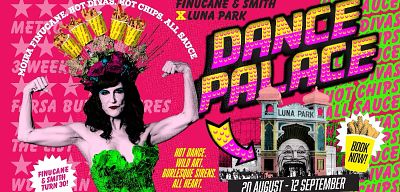
Finucane & Smith X Luna Park Dance Palace
Click here if you liked this article 6 
https://www.finucaneandsmith.com/
Date Reviewed: 23/08/2026
Moira Finucane told the audience there was no better place to stage Dance Palace than the newly restored Luna Palace at St Kilda's Luna Park. An asylum might also have done the trick; bedlam, after all, is the order of the night.
Celebrating 30 years of Finucane & Smith, Dance Palace throws velvet, sequins, nudity, music, colour, and anything-goes mayhem into a carnival of burlesque, cabaret, circus, drag, avant-garde butoh, belly dancing, Bollywood, torch songs, and performance art. In three decades, the company has created 36 full-length shows, performed in 19 countries, toured 160 Australian towns, reached over a million people, and won 21 awards, all without a penny of ongoing funding.
And then there are the undies (not the knickers you'll throw at them, but the ones they throw at you). Finucane strips off her pants to reveal another pair, then another, and another, nested like a babushka doll. It is childish, silly, and deliberately ridiculous.
“Am I missing something here?” I wonder as the audience erupts in laughter that I'm simply not feeling.
“They're all clearly in on something we're not,” my theatre companion observes, as I ponder whether I can leave my seat mid-performance for a stiff drink to get me through the night.
The pants routine escalates throughout the evening with Finucane's far more aggressive “red undies” number from Glory Box in the second half: red lingerie with love hearts angrily snapped off to make way for nails, red balloons, and a woman seemingly at war with the colour red. What begins as a striptease devolves into comic destruction-burlesque turning against itself.
Finucane quips that critics, audiences, and academics have all written about her work, even in Australasian Theatre Studies. “I never did study theatre,” she says, and I believe her. She studied wetlands, which I don't believe at first, though it turns out to be true.
During the break, a performer in a cowboy hat informs me Finucane is actually completing a PhD* on krill and then encourages me to draw one for Moira's doctoral thesis. I learn so much about krill during the show that I realise I've gleaned more about Finucane's doctorate than my own daughter's (which may or may not be about spinal cord injuries or studies to that effect). Somewhere, thousands of PhD students, including my daughter, are hunched over theses on caffeine and despair, while Finucane draws krill and spins her research into cabaret and epic poetry.
Right on cue, gender-diverse jazz singer Mama Alto delivers "I Will Survive" in a rainbow gown, hitting high notes that would make Gloria Gaynor check her passport. Yumi Umiumare brings extraordinary physicality; Bendy Ben morphs between showgirl and showghoul; Govind Pillai blends Bollywood and boylesque; Maple Rose delivers classic burlesque; and Zitao Deng arrives with pop-star glamour.
Raksha Parsnani lights up the stage with a sensual belly-dancing routine. My companion, who studied the art for a year, is floored by her technique, while I simply soak in Raksha's magnetic aura and energy. It is hard to believe her day job is strategic product leader and software engineer. Meanwhile, Yorta Yorta-Taungurung artist Glennys Briggs and country singer Ian Muir weave First Nations music and storytelling seamlessly into the fold.
Bodies of every shape, age, ethnicity, and texture are visible: young, old, slim, voluptuous, angular, hairy, smooth, cellulite and all. Gender is fluid, sexuality is playful, and conventional beauty gets very little say.
Above all, the performers fiercely believe in the work. Kate Foster provides one of the night's most affecting moments, sharing how a life event caused her to lose her voice and confidence, stopping her from singing for seven years. She thought her talent was gone until Finucane found her.
“She'd never heard me sing before,” Foster says. “She put me on stage without any rehearsal or warning and said, ‘Sing.’ I've been singing ever since.”
That, more than any manifesto, is telling. It explains both the appeal of and need for Finucane & Smith. They don't just put unconventional performers on stage; they convince them they belong there, weaving diversity directly into their casting philosophy and aesthetic.
The gloriously eclectic cast doesn't remain on stage, either. They sit along the aisles, seat the audience, mingle, cheer, and act like a live human laugh track.
There is something unmistakably Eurovision about it all: the colour, camp, spectacle, and unapologetic celebration of difference. At times, it feels like Eurovision trapped overnight in a burlesque club. Yet beneath the tinsel, Finucane touches on the "polycrisis": war, climate anxiety, political upheaval, and a world that has misplaced the plot (and is in desperate need of more krill). Her answer isn't solemnity; it is connection, absurdity, beauty, and the stubborn insistence on making joy anyway.
Finucane recalls that early on, "Everybody, including some of the people who worked for us, said it wouldn't work.”
I'll admit, parts of the show made me cringe, and others made me ask, "Why?" I've seen more polished burlesque; shows like Blanc de Blanc at the Spiegelhaus offer greater technical precision, slick choreography and cookie-cutter looks. Dance Palace is messier. Its anything-goes philosophy occasionally feels liberating and occasionally feels like "okay, whatever".
But when Zitao Deng takes the stage, glamorous, misty-eyed, and vulnerable in a red ballgown, hair flowing to deliver the final song, the shift is spellbinding. (Australia, please send this to Eurovision-full backup vocals of the cast included.) It is the perfect crescendo for a show that spent two hours celebrating eccentricity and the sheer pleasure of being alive.
By the finale, the entire room is buzzing. The show ends less like theatre and more like a well-dressed riot, performers and audience blur together as the dance floor takes over, and suddenly the bedlam has a point. Perhaps Dance Palace isn't always slick or coherent, because it doesn't need to be. Its originality lies in making room for everything and everyone: aging bodies, queer performance, First Nations culture, Asian influences, pop, politics, absurdity, and a PhD about krill.
Thirty years after being told it wouldn't work, Finucane & Smith are still here taking risks, creating space, and sending audiences out into the night dancing. Bedlam never looked so fun.
You might groan in the beginning but yawn you will not.
Highlights:
High-energy Bollywood dancing, the historic venue, inclusive diversity across all shapes and ages, performers who mingle right alongside the crowd, and a post-show dance party that seamlessly turns the finale into an open social celebration. Another highlight is that if you, like me, feel a little insecure about getting older and what gravity has done to your body, you'll feel a little less critical after the normalisation of so many body types that are revealed in this show.
Suggestion:
Come dressed glam, with extra points for feather boas, glitter make-up and cowboy hats.
Who's it for:
The open-minded, progressive, and anyone who loves unapologetic cabaret. (Just don't bring PhD students as it may unleash some trauma.)
Written by Mary Sinanidis
* PhDs: Thanks to generous federal funding (yes, your taxpayer dollars at work!), Australian universities grant researchers immense freedom to pursue niche, bizarre, and questionable passion projects. While dissertations theoretically aim to solve complex social or environmental problems, taxpayer money has famously funded studies into the thermal comfort of wet underwear, the fluid dynamics of penguin poop, the economics of lap dancing, and the cultural impact of Harry Potter. So really, an epic poem about krill is practically a sensible investment.