TWO
Click here if you liked this article 8 
https://www.theatreworks.org.au/2025/two
Date Reviewed: 12/12/2025
TWO, the new work by Artemis Munoz, aims to explore non-binary parenthood, identity, and the pressures placed on a pregnant person whose gender expression challenges social norms. It’s an ambitious premise, but what unfolds is less a nuanced study and more an exercise in ideological indulgence.
The theme isn’t the problem: gender identity is worthy territory. The issue is that parenthood becomes an afterthought to pronouns. Kit’s pregnancy is treated symbolically rather than realistically, and the emotional core is repeatedly overshadowed by speeches about identity politics and linguistic correctness.
For a play about becoming a parent, it offers surprisingly little insight into the emotional, physical, or relational realities of raising a child. It gravitates toward theory over lived experience, speaking about parenting without ever understanding it.
One of the most troubling elements is the recurring drift toward parental alienation. Kit’s mother fumbles pronouns, awkwardly, not maliciously, and is immediately shut out. There’s no allowance for generational learning; mistakes are weaponised, and “boundaries” become shorthand for emotional withdrawal. Meanwhile, Kit lies (“It’s twins”) and behaves selfishly without accountability. Forgiveness flows one way; blame flows the other. It creates a world where family becomes disposable at the slightest ideological slip: unrealistic and, frankly, unhealthy.
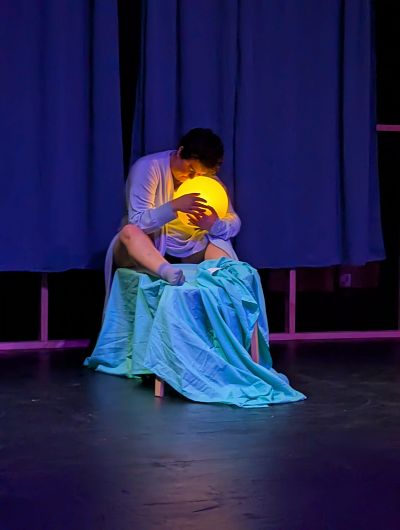
Symbolism dominates the production, but the staging fails to translate the script's lofty ambitions into an experience that resonates beyond the conceptual. The glowing-orb baby is visually striking but epitomises the detachment from the physical reality of birth and infancy. It is not a symbol of hope; it is a cold, remote stand-in for emotional depth.
Realism slips throughout: character behaviour is erratic, emotional shifts lack logic, and pregnancy details miss the mark. The ending lands rushed and unearned.
Performance and pacing
The acting sits firmly in "Home and Away" soap-opera-styled territory: earnest, occasionally melodramatic, sometimes wooden. The ensemble struggles to navigate the script’s rhetorical demands while maintaining emotional truth. Sienna Macalister (Kit) carries the show capably, with flashes of vulnerability, but the script undercuts them by externalising conflict rather than allowing it to simmer internally. The supporting cast does its best with limited material.
Pacing suffers under the weight of dense dialogue, made worse by a thin sound design that creates no atmosphere and leaves actors fighting the room’s dead acoustic.
This was the emptiest I’ve ever seen Theatre Works. Audiences vote with their feet, and tonight the vote wasn’t encouraging.
This production, despite confident political intention, confuses certainty with nuance, taking a compelling idea and turning it into an alienating lecture. More didactic than intellectual.
There is definitely a powerful play to be written about non-binary parenthood and intergenerational misunderstanding. This isn't it.
Highlights
- The bookstore venue is warm and inviting.
- The Acknowledgement of Country was heartfelt.
- Front-of-house staff created a relaxed, welcoming atmosphere
- A TV screen where you can follow the script (not always on-point but fun to catch potential slip-ups)
Who’s it for
TWO will resonate most with audience members who enjoy theatre driven by identity politics, metaphor, and conceptual storytelling rather than realism or traditional character arcs. It may appeal to those already invested in conversations about gender and self-definition, or viewers who prefer theatre as a platform for ideological statements over nuanced family drama.
For those seeking emotional complexity, balanced intergenerational storytelling, or an authentic depiction of pregnancy and parenthood, this production may feel alienating.
Reviewed by Mary Sinanidis