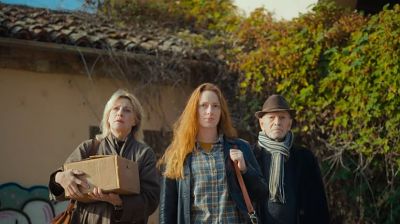
Trifole | Europa! Europa Film Festival 2026
Click here if you liked this article 5 
https://www.europafilmfestival.com.au/
Date Reviewed: 04/02/2026
Trifole (2024), directed by Gabriele Fabbro, moves like a modern fable: slow, steeped in symbolism, and dreamlike. It feels perfectly at home in the Europa! Europa Film Festival program: a film that trusts stillness, atmosphere and myth over narrative urgency.
Set in the misty forests and fading villages of Piedmont, Trifole asks for patience and rewards it with texture, mood and a lingering emotional ache. This is Slow Cinema at heart, meditative, tactile, deliberately paced, but it gradually fractures into allegory, slipping into fairy tale.
The story is deceptively simple. Dalia, a young woman who is disenchanted with her life and literature studies, travels from London to rural northern Italy to care for her aging grandfather, Igor, a legendary truffle hunter whose memory is beginning to fail. Igor lives alone with his beloved dog, Birba, in a weathered house, pressed in on all sides by corporate vineyards.
The rolling vineyards are undeniably beautiful, yet to Igor they represent a modern world steadily erasing older ways of living. He says: “I love this land. To love this land means to not be alone. It means that in every stone, in every tree, there’s something that’s yours. That even when you’re gone, it will talk about you. My roots are here. My trees are here. My memories. And now they want to erase me. Do you understand? They want to erase me.”
Together, Dalia and Igor hunt truffles in damp forests, guided as much by lore as by instinct, chasing the elusive lightning-struck white truffle said to be born from storms and divine intervention.
From its opening moments, cinematographer Brandon Lattman lingers on mud, bark, fog and rain-soaked leaves. The camera stays low, often at ground level, as if foraging alongside the characters. There is little dialogue and even less exposition. Meaning accrues through repetition and sensation: boots sinking into wet earth, breath clouding in the cold, Birba’s quiet concentration. The Italian countryside is not postcard-pretty but worn and autumnal—decaying homes, abandoned rooms, villages emptied of people. Igor’s house, by contrast, is drenched in earthy tones and cluttered with objects and memories, a living archive of a vanishing world.
Water becomes the film’s dominant element. Rain, creeks, mud and storms are everywhere, binding sky to soil. Igor speaks of Jupiter, lightning and rainfall as necessary forces for truffles to exist. Water is both practical and mythic: the lifeblood of the forest and a symbol of favour from unseen powers. It also mirrors Igor’s dementia; memories flowing away, time washing over him. For Dalia, water is cleansing as she drinks from creeks and streams as if baptising herself into this unfamiliar life.
As the days pass, Dalia grows enchanted. What begins as reluctant caretaking turns into fascination, then devotion. She finds a new passion in truffle hunting. In an abandoned house, she discovers a mural that resembles a tapestry of her own life, a visual echo of the stories she has been searching for but failed to find in books. Trifole is deeply concerned with where meaning resides: on the page or in the land, in theory or in touch.
Midway through, the film performs a striking stylistic pivot. The quiet realism of the forest gives way to something stranger and darker. Birba is poisoned by an unseen rival, the prized truffle is stolen, a devastating moment that marks the film’s emotional core. Shortly after, she glimpses a wolf, an animal Igor once described, before it vanishes when she wakes. Reality loosens its grip. The truffle hunt becomes a quest, and Dalia steps fully into the logic of fable, where loss precedes transformation.
This shift culminates in the film’s most audacious sequence: the Alba truffle fair. Suddenly, the still camera goes handheld; the forest hush is replaced by crowds, lights and noise. Dalia crashes the event wearing a medieval gown and crown, joining a procession of truffle “princesses” who escort the prized fungi into a high-end auction. It is absurd, exhilarating and knowingly theatrical, a fairy tale colliding head-on with capitalism. Watching Dalia sprint through nightclubs and stairwells in full regalia feels like folklore rebelling against modernity in real time.
Yet Trifole resists easy consolation. There is no fairy godmother to save Igor’s house, no magical fix to halt progress. Change may be inevitable, the film suggests, but it comes at a cost. Traditions are not just practices; they are vessels for memory, labour and identity. When they vanish, entire ways of understanding the world disappear with them.
Umberto Orsini delivers a quietly devastating performance as Igor, balancing vulnerability, humour and stubborn dignity. His presence grounds the film’s more whimsical turns. Dalia, played by co-writer Ydalie Turk, carries a slight opacity that mirrors her character’s uncertainty; her awakening is internal rather than expressive, felt more than declared.
In the end, Trifole is less about truffles than about inheritance; what is passed down, what is lost, and what must be relearned through experience rather than instruction. It asks viewers to slow down, to feel the cold and wet, to listen to stories half-remembered and half-invented. Like the truffles it reveres, its beauty lies underground, revealed only to those willing to dig.
Highlights
- Lush, tactile cinematography that treats the Piedmont landscape as a living character
- A confident shift from Slow Cinema into modern fable and magical realism
- Umberto Orsini’s tender, deeply human performance
- The Alba truffle fair sequence—playful, chaotic and unforgettable
- Thoughtful exploration of memory, tradition and generational inheritance
- Birba the dog!
Who’s it for
- Fans of Slow Cinema and contemplative filmmaking
- Viewers drawn to folklore, allegory and modern fairy tales
- Audiences interested in rural life, disappearing traditions and intergenerational stories
- Those willing to trade plot momentum for atmosphere and texture
The film is part of the Europa! Europa Film Festival, an annual event that showcases European cinema. This year, it features 43 films from 22 countries, and runs from February 10 to March 19. It runs in Melbourne, Sydney, Brisbane, Hobart and Aukland.
Reviewed by Mary Sinanidis