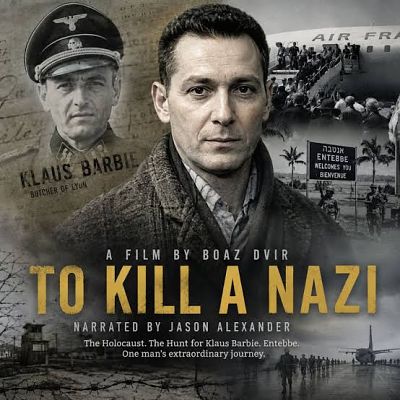
To Kill a Nazi - Jewish International Film Festival 2026
Click here if you liked this article 0 
https://www.palacecinemas.com.au/movies/jiff26-to-kill-a-nazi
Date Reviewed: 26/10/2026
Reviewed by Nicolas Van Der Haar
“We can be redeemed only to the extent to which we see ourselves.” — Martin Buber
This quote opens To Kill a Nazi and works as a remarkable framing device for exploring this fascinating life story.
It raises an uncomfortable question about the relationship between understanding ourselves, confronting history, and seeking redemption through acts of violence.
To Kill a Nazi is a fascinating film by Boaz Dvir that explores the Second World War history of Holocaust survivor Michel Cojot and his mission to murder Klaus Barbie, the notorious Nazi war criminal known as the Butcher of Lyon.
The documentary slowly unfolds, exploring a fascinating narrative backed up by living testimony.
Michel’s obsession with knowing what happened to his father, and then attempting to assassinate Klaus Barbie, is fascinating and rendered in an interesting animation style. On the whole, the animation in the film is clever but also a bit distracting. It offers a way of reconstructing events that might otherwise be difficult to visualise, although its stylisation occasionally competes with the gravity of the testimony.
The seriousness of the narrative also undercuts some of the more humorous elements, including convincing his employer, a business in Caracas, to help him get physically closer to Barbie.
The ultimate twist, which I will spoil because you can Google this fact, is that he did not kill Klaus Barbie. The revelation shifts the story away from the anticipated satisfaction of revenge and towards something more ambiguous. The absence of purpose in this man’s life becomes a fascinating narrative in and of itself. Living separately from his family and struggling to deal with his emotional issues, Cojot emerges as a man whose pursuit of justice has become inseparable from his own personal turmoil.
Michel’s unusual connection to the 1976 Entebbe raid is fascinating but a little odd. Although this connection adds another unexpected dimension to his life, it also makes the documentary feel as though it is occasionally reaching beyond its strongest material. I think this film would have worked much more strongly if it had been framed as a family’s retrospective on their patriarch rather than calling itself To Kill a Nazi. The title promises a story of pursuit and retribution, whereas the more compelling film concerns the personal aftermath of historical violence and the difficulties of living with its consequences.
Michel Cojot had a fascinating and unusual impact on history and modern politics. I love documentaries about these kinds of small and strange parts of human existence. Great documentaries like this should exist because it is important to tell the stories of those who do not demand the spotlight. There are plenty of individuals online and in the world who crave attention, demand it, and suckle at the fetid teat of popular entertainment. Individuals like Cojot did not crave attention but were thrust into the spotlight by chance and opportunity.
I found the story of Cojot interesting because of its unusual twists and turns. It makes for an entertaining documentary. Its greatest strength is its attention to an individual whose life sits somewhere between the margins of established history and the personal consequences of its most terrible events. Not every life needs to produce a heroic resolution to warrant examination. Sometimes the unresolved, uncomfortable, and even apparently futile aspects of a person’s existence are precisely what make their story worth telling.
Ultimately, To Kill a Nazi raises difficult questions about the relationship between justice, revenge and the lasting impact of trauma. What happens when the pursuit of justice becomes the defining purpose of a survivor’s life? Can revenge offer any meaningful resolution to historical suffering, or does it risk prolonging the very trauma it seeks to overcome? Cojot’s story suggests that the desire to confront the past is not always accompanied by the means to resolve it. There is a profound difference between holding perpetrators accountable and expecting vengeance to repair what has been lost. The film is an engaging, if occasionally uneven, documentary about a man whose extraordinary pursuit of a war criminal reveals as much about the burden of survival as it does about the desire for retribution. Its most interesting questions linger long after the film ends, even if its framing does not entirely do justice to the complexity of the life it presents.