The Gospel According to Paul
Click here if you liked this article 2 
https://www.artscentremelbourne.com.au/whats-on/2026/comedy/the-gospel-according-to-paul
Date Reviewed: 20/10/2026
Reviewed by Nicolas Van Der Haar
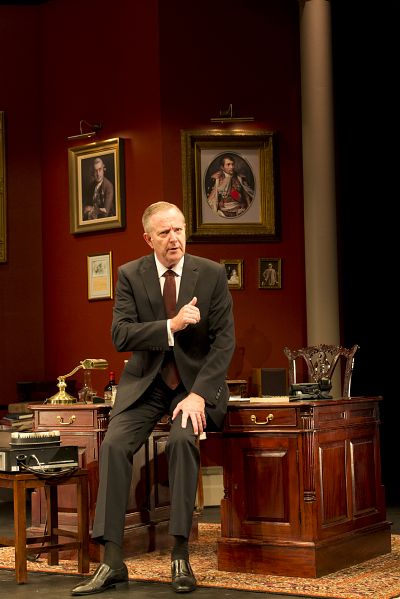
We are greeted with a rich burgundy set littered with grand European portraits, an enormous record player, a literal throne, and carriage clocks. Very Paul Keating, I thought. I suspect that is what the audience also thought as they carefully assembled.
Jonathan Biggins has done a remarkable job at blending political comedy and stage drama. His impression of Keating is subtle and profound. This isn’t a caricature of a political figure but a clever deconstruction of a man who would, in my estimation, keenly stick his hand up for the role of President of an Australian Republic if given the chance.
Biggins captures Keating’s natural lyricism and witty repartee, as well as his gift for political theatre. I had to keep reminding myself that this wasn’t Paul Keating onstage. Biggins is a marvellous actor and impressionist.
Legacy is a major theme, carried through by blisteringly clever writing. The show offers a razor-sharp history of modern Australian politics, beginning with Harold Holt and Menzies and trundling through the decades with a healthy supply of jokes. It is a brisk, entertaining account of a country and a politician rather fond of a grand narrative.
My previous perception of Keating is of a warm, genial kind of cynical arrogance. As an amateur historian of Australian politics, I had some quibbles with the narrative. Obviously, the production is designed to present the Paul Keating we expect to see: verbose, dynamic, and bold in equal measure.
In my personal reading of history, Keating never admired Whitlam’s social policies enough to put money behind them. He advocated for a national vision of Australia as an independent world power but was never particularly keen on putting actual cash behind that vision. Despite all the carping about what he would have done in Whitlam’s place, Keating would never have purchased Blue Poles for the Australian people. There is a difference between imagining a nation and paying for one.
The tradition of Labor dealmaking is only touched on briefly when discussing Bob Hawke, Keating’s infamous rival. I would have liked to see this explored more fully. Their relationship offers plenty of dramatic material, although perhaps it’s difficult fitting this theme into one evening.
Keating’s peculiar obsession with artifice and artificiality is another interesting contradiction, particularly alongside his work ethic and political networking. He describes beginning his political journey at nineteen or twenty and dedicating his life to public service. Yet the cost of this commitment receives comparatively little attention. For a show so concerned with legacy, I wanted more consideration of what happens when politics becomes not merely a profession but an entire personality.
*A tiny, single spoiler ahead*
The music in the show is also cleverly employed to break up the extended monologue, giving the performance welcome variation without sacrificing its momentum.
Ultimately, The Gospel According to Paul is a celebration of Keating in a similar vein to Keating! The Musical. It presents the former Prime Minister as a constructive force in Australian life and culture, a man whose ambitions extended beyond the parliamentary chamber to the very identity of the nation.
Keating would probably approve.