The Enormous Radio | Fringe Festival
Click here if you liked this article 2 
https://thesubstation.org.au/program/the-enormous-radio
Date Reviewed: 04/10/2026
At the foyer, we are given instructions:
- Switch off your phones.
- No photos.
- Your devices could interfere with the performance.
- We will guide you out if you need to go to the toilet.
- Leave food on the table outside.
It's a promising start to The Enormous Radio, where interference seems to be the main attraction.
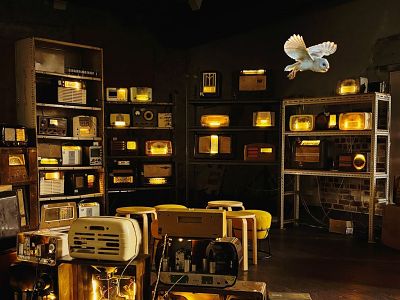
Inside The Substation in Newport, old radios, screens and electronic equipment form a circle on a round red carpet, cables messily worming their way to their sockets beneath them. Philips, Sony, Loewe: household names from a time when turning a dial brought the world into your lounge room. Once, these boxes delivered news, music and company. In this performance, they look ready to contact the dead, poised as though a tech seance is about to begin.
We have time to wander among them. I wonder who owned them, what kitchens they sat in, what arguments their broadcasts drowned out. There is something touching about equipment that has outlived its usefulness, waiting for someone to switch it on again.
Roslyn Oades and Bob Scott, working with collaborators, give it a strange new job. This Chamber Made installation at Melbourne Fringe uses Australian wildlife recordings, sound composition and translation software to imagine what the animal world might be trying to tell us. With the climate emergency as its backdrop, you suspect the message won’t be “having a lovely time”.
First, though, we cruise through radio’s glory days.
Fragments of broadcasts float past: Remember When on 3AW, Ben London introducing the news on 2CH. It sounds like a radio left playing in another room. Familiar voices from another time, half-heard chatter, my mind involuntarily goes to my mother's kitchen with John Laws talk show playing in the background just before the dial slips.
A rising cackle of bird calls break through the static. And then, in a suspenseful Hitchcockian way, screens flicker. Words appear and disappear before I can catch them, while lights sweep through, soothing blues, warning reds, aligned with sound swells, rising and ebbing like waves, until I feel the vibrations inside my body. Beneath The Substation’s high ceilings, the noise has room to roam, echoing as it bounces from wall-to-wall.
Then comes an accusation.
“IT’S A LOT, IT’S A LOT, MURDERER.”
Who is speaking? Who is the murderer? Is the animal kingdom pointing a claw at us?
"DEVIL A. DEVIL AWAY."
The letters click away, sounding like messages in morse code.
For a moment, I’m hooked. By this stage, the cosy world of familiar broadcasters has turned hostile, and I want to know where this confrontation will lead. But the charge hangs in the air, then slips away into the next puzzle.
Only afterwards, through reading about the work, do I discover that its six transmissions feature Tasmanian devils, pobblebonk frogs, red-tailed black cockatoos, blue whales, dingoes and boobook owls.
Working with text dramaturg Sarah Walker, Oades feeds their recordings into voice enhancement and translation software, asking it to recognise English words. The text comes from what the machine thinks it hears.
That is a deliciously odd idea: wildlife put through a digital interpreter, with results that sound like threats from a faulty oracle. During the performance, however, as a viewer oblivious to the message the creators tell me I'm supposed to feel, the messages are Pinteresque and I struggle to grasp what connects them. I’m trying to solve a mystery without knowing the rules.
There are only three of us at my session, which makes for a private show where the equipment has the floor.
Production designer Jenny Hector gives this gathering of ageing electronics an eerie presence, helped by Matt Milne’s lighting programming. Technology designer Kevan Atkins, with technician and antenna designer Sam King, brings the obsolete network to life.
Sound travels around and through us. These machines may be retired, but they can still make a room tremble.
The trouble is that my attention doesn’t always tremble with it, and after a while, and following a number of repetitions, I close my eyes and grow drowsy. It feels like I am in a sensory room with flickering lights and the sound of status. I came prepared for a haunting, but at times I feel ready for a nap.
The work doesn’t need to explain every flicker or hand us a tidy story. A little uncertainty is part of the pleasure. But there is a difference between being drawn into a mystery and waiting for the next interesting noise.
That cry of “murderer” could have been the turning point. I would have liked to have seen the animal calls fracture the human chatter in a more linear way. They should have built to a crescendo until they became harder to ignore, and then cut everything to sudden silence or perhaps have one of the radios explode like a shot followed by darkness and silence.
Leave us sitting there, with the accusation still ringing, lingering.
A brief introduction to the animal recordings and the machine’s role would also have helped. It would give us a way into the experiment without explaining away its strangeness. As it stands, the climate message is clearer in the reading of the program than in the room during the performance. I hear a world behaving oddly, but rarely feel the urgency of a world in danger.
At $20 general admission, roughly the price of a movie ticket, The Enormous Radio offers an inventive encounter with technology most of us have long since discarded. It has atmosphere, technical skill and flashes of real bite.
But once the animal world has called us murderers, the following repeated bursts of static feel like letting us off lightly.
Highlights
- A striking circle of old radios, screens and electronic equipment.
- Unsettling messages emerging from wildlife calls.
- Sound that gets under your skin, sometimes literally.
- The novelty of the installation that lets the audience do much of the interpretation.
- The odd comfort that old things can reinvent themselves (especially useful for someone my age).
- The impressive repurposed venue that is ideal for an installation like this.
Who’s it for?
Radio enthusiasts and experimental art lovers who enjoy piecing together a mystery.
Reviewed by Mary Sinanidis