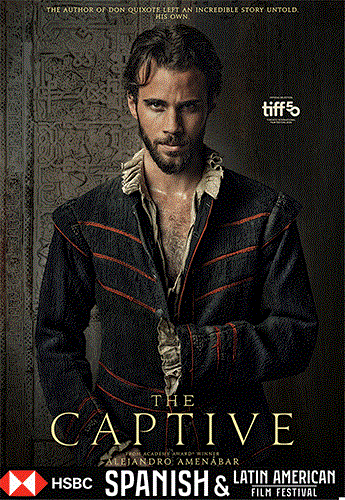
The Captive (El Cautivo) | HSBC Spanish Latin American Film Festival 2026
Click here if you liked this article 10 
https://www.palacecinemas.com.au/movies/spa26-the-captive
Date Reviewed: 28/05/2026
There is a question that sits beneath many great works of art: what experiences shaped them, and what price was paid in their creation? Alejandro Amenábar's ambitious historical drama The Captive (El Cautivo) explores that question through the life of Miguel de Cervantes, examining the years of captivity that preceded the writing of Don Quixote. Screening nationally as part of the HSBC Spanish & Latin American Film Festival presented by Palace Cinemas, it is one of the programme's standout films: a thoughtful historical drama about suffering, resilience, and the transformative power of storytelling.
Before Miguel de Cervantes wrote Don Quixote, one of the most influential novels in the history of Western literature, he spent five years as a slave in Ottoman Algiers. The film asks what that experience did to him, and what he did with it.
It is a more interesting question than it might first appear. History is full of creatives whose defining work was forged not despite their suffering but directly through it. Mary Shelley wrote Frankenstein while grieving, isolated, and barely out of adolescence. Marcel Marceau developed the silent art form that would make him world-famous while helping Jewish children evade Nazi detection during the Second World War. In each case, hardship did not obstruct creativity. It became the material. The Captive positions Cervantes within that same lineage, and in doing so gives his story a resonance that extends well beyond the historical drama genre.
Julio Peña Fernández plays a young Cervantes with grounded, watchable intensity: a wounded 28-year-old Spanish soldier seized at sea by Ottoman corsairs in 1575 and sold into the notorious Bagno prison of Algiers. What the film understands, and what gives it its most interesting dimension, is that Cervantes did not simply endure captivity. He observed it. He narrated it. He found in the prison cells, the power struggles, and the strange intimacies of cross-cultural confinement the raw architecture of fiction. The storytelling instinct, the film argues, was not something Cervantes brought to Algiers. It was something Algiers gave him.
That cross-cultural dimension is one of the film's genuine strengths. Amenábar takes care to render the Ottoman world not as a theatre of menace but as a fully realised society with its own codes, contradictions, and moments of unexpected humanity. For audiences accustomed to encountering this period of Arab and Christian history through a purely European lens, the perspective feels genuinely fresh. The film does not reduce its Ottoman characters to obstacles or antagonists. It grants them interiority, which is both a directorial choice and, quietly, a political one.
Alessandro Borghi plays Hassan Pasha, the feared Bey of Algiers, and the film explores the charged relationship between captor and captive with more restraint than its premise might suggest. The speculative romantic dimension is present, and it adds emotional texture, but the more compelling thread is what the relationship reveals about power, survival, and the lengths to which a person will go to remain intellectually and creatively alive under impossible circumstances. Cervantes, the film suggests, did not merely tolerate Hassan Pasha. He studied him. And somewhere in that study lies Don Quixote.
The supporting cast earns its place. Miguel Rellán's Antonio de Sosa, a scholarly priest and fellow captive, brings warmth and intellectual companionship to the prison's shared suffering. Fernando Tejero's Friar Blanco de Paz is a sharper, more corrosive presence, a study in institutional pettiness that serves as a useful reminder that moral failure is not the exclusive property of any one culture or faith. Luna Berroa's Zoraida, the Moorish woman who becomes Cervantes' love interest, is handled with care. Her character carries a direct literary echo: she is the prototype for the Zoraida of "The Captive's Tale", the autobiographical interlude Cervantes would later embed within Don Quixote itself, encoding his Algiers experience into fiction almost before he had fully left it behind.
The film took home Best Makeup and Hairstyles at the 40th Goya Awards, and the production is meticulous throughout. The settings carry genuine weight. At two hours and fifteen minutes, the runtime is earned rather than indulged.
What stays with you is not any single scene but the film's underlying argument: that enduring creative work is not produced in comfort. It is produced in the gap between who a person was and who circumstance forced them to become. Cervantes left Algiers a different man than the soldier who arrived, and whatever was broken or transformed in those five years became the imaginative foundation for a novel that has never gone out of print. The Captive does not fully resolve the mystery of how that transformation happened. But it asks the question with enough intelligence and craft that you leave the cinema turning it over in your own mind.
That, in the end, is what the best historical cinema does. It does not simply reconstruct the past. It makes the past feel urgent.
The HSBC Spanish & Latin American Film Festival is screening nationally at Palace Cinemas. Full program details at palacecinemas.com.au.
Reviewed by Anushka Dharmadhikari