Savages
Click here if you liked this article 7 
https://www.theatreworks.org.au/2026/savages
Date Reviewed: 03/09/2026
I was roughly ten minutes late to Savages, partly because the theatre shares a similar name with another theatre in St Kilda and partly because I am not a native to this thoroughly alien suburb of my Melbourne. It’s much too touristy to be a suburb and much too suburban to be a tourist town. Makes for good wine bar country though, I’ll say that much. It was an inauspicious beginning, but Savages quickly made me forget my geographical confusion.
Patricia Cornelius has written a superbly funny work, and she is something of the Helen Garner of Melbourne theatre. I think Cornelius should be awarded some kind of jewelled sceptre and crown combination before they decorate reliable Helen with a knighthood or some nondescript Australian Honours. Her writing is sharp, funny and deeply interested in the absurd contradictions of masculinity.
The production is also blessed with masterful set design. The show cleverly plays with all the tropes of a holiday: the escape from ordinary life, the promise of renewal, the possibility that somewhere else we might become someone else. These characters yearn for change, renewal and rejuvenation, although what kind of change they actually want is never fully explained. Perhaps that is because they cannot understand it themselves.
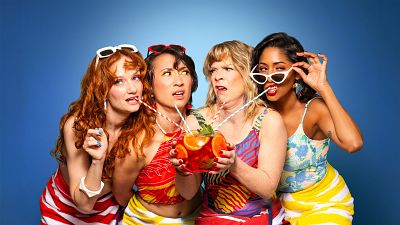
The gender-bending of the characters is fascinating. At first, I was unsure why these characters were being played by women, but by the end, I had been completely won over. There is something liberating about watching these hyper-masculine men precisely because their masculinity is almost entirely artificial. At times, the show reminded me of a Fleabag-style television comedy, as if performed by a Steve Buscemi or Robert De Niro. The absurdity is part of the success of Savages: these men are recognisable, but they are also ridiculous.
The lighting and music work superbly alongside the play and cast, fitting the production remarkably well. I have to salute Harrie Hogan and Jess Keeffe for the superb framework they provide to the show.
The satire and themes employed here work well and slowly become inextricably linked in a kind of snake-like constriction. The toxic dialogue is particularly clever. These men have a talent for speaking with another’s voice, repeating the language and attitudes they have inherited from elsewhere. In attempting to perform strength, they demonstrate, often accidentally, how truly weak they are.
Their infantile nature reaches a peak when George begins to separate from the group. Their mutual toxicity is ultimately what brings them back together and binds them to one another. They are trapped in the very relationships that make them miserable because those relationships are also the only ones through which they can understand themselves.
As each character’s personal life becomes more exposed, they slowly become stereotypes of masculinity. The truth exposes these men and makes them feel worthless, but that is ultimately because they were raised to feel awful and worthless by their parents.
The toxic manosphere themes in the work blossom fully during the “gentleman’s” first night out. They scheme to drug a woman, and the show transitions into a darker kind of play: more abstract, more physically daring and considerably more disturbing. The comedy curdles. What had previously seemed like male bonding suddenly reveals the violence that sits beneath it.
This is where Savages becomes particularly compelling. The holiday has promised escape, but instead these men have carried themselves with them. There is no easy renewal waiting for them.
The end is cold and diabolical, stripping away the raw artifice of the show. It is a masterful piece of theatre, performed masterfully by an incredibly talented cast. The production’s ease and willingness to move between comedy, physical theatre and something genuinely unsettling is its greatest strengths.
The whole cast’s enthusiasm and commitment transforms what could otherwise be an anarchic representation of white, heteronormative mate-ship into something compelling and contemporary. Particular attention should be paid to Rabbit (Aya) and Runt (Nicci Wilks), whose performances were particularly sharp and impactful.
Ultimately, I was won over by the masterful acting. The performances helped modernise Savages’s examination of masculinity. Savages is funny, painful and occasionally horrifying. It is deeply interested in the ways men inherit their ideas about themselves and the damage those ideas can cause. What begins as a holiday among a group of ridiculous men gradually becomes something much more sinister, a portrait of toxic masculinity built from inherited pain, weakness and the desperate need to feel something genuine.
Reviewed by Nic