Árru | Hurtiger Nordic Film Festival Opening Night
Click here if you liked this article 3 
https://nordicfilmfestival.com.au/films/nor26-arru
Date Reviewed: 11/07/2026
NOTE: This review focuses on the overall opening night event experience of the Hurtigruten Nordic Film Festival at the Astor Theatre (Friday, 10th July) rather than just Árru, the opening night film.
If you attended opening night expecting a conventional experience, you might have walked away disappointed. However, there is something incredibly refreshing about the Hurtigruten Nordic Film Festival that immediately sets it apart from other cultural film opening nights. Unlike festivals that rely on elaborate costumes, loud fanfare, or overwhelming spectacle, opening night at the Astor Theatre resembled something unmistakably Nordic: understated confidence.
Festival Director and Programmer Elysia Zeccola welcomed the audience by describing Nordic cinema as “a force to be reckoned with”, celebrating filmmakers from Denmark, Finland, Iceland, Norway, and Sweden who showcase “breathtaking landscapes and unique storytelling”. She singled out the opening night film, Árru, as a rare opportunity to experience Sami culture, reindeer herding, and the ancient tradition of joik singing. She said it was “a really unique film to see a different part… so exotic for Australia.”
The evening, both on screen and at the foyer, reflected the Nordic philosophy of restraint. In the foyer, guests wandered casually between themed photo booths, festival banners and sponsor displays while Pioneer of the Fjords, the live trio, quietly filled the space with ambience, becoming a natural part of the atmosphere.
The crowd who attended was dotted with distinct pockets of Scandinavian voices, giving the evening the curious sensation that you had already travelled across the globe before the first frame appeared on screen. Around us, quiet internal joy and low-key chatter.
The catering by Delidanois followed the same minimalist approach. The spread featured three IKEA-styled Nordic-style meatballs, a dollop of potato salad, an open sandwich piled with a thin orange slice (unpeeled) and garnitures, a packet of True Dates for the show, washed down with sparkling wine and champagne. It was just enough to make the evening feel special without distracting from the cultural focus of the night.
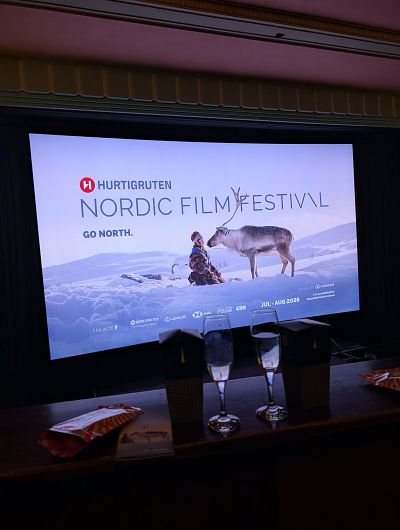
A prominent feature was the festival poster, a striking shot from Árru, its central figure standing alongside a reindeer against an endless snowy landscape. A great choice that captures the festival’s identity with authenticity, showcasing Nordic rugged beauty and a deep connection to nature. It perfectly foreshadows the kind of cinema audiences can expect throughout the festival: visually breathtaking, culturally rich, and unafraid to tackle complex human stories.
And now for the film...Arru
In the North Sami language, Árru translates to “scar” or “trace”, a title carrying both literal and emotional weight. In the film, director Elle Sofe Sara explores the scars left on Indigenous lands by industrial development alongside the invisible trauma carried through generations of Sami families.
The Sami, known as the last Indigenous people of Europe, live across the Sapmi, a region stretching through northern Norway, Sweden, Finland, and Russia. The film follows Maia (Sara Marielle Gaup Beaska), a reindeer herder fighting to protect her ancestral grazing lands from a proposed mining project while confronting devastating family secrets that threaten to destroy her community from within.
Steeped in symbolism, the highlight of the film is its opening sequence where snow blankets the landscape as a distressed reindeer miscarries. Puddles of blood stain the white tundra, and Maia buries the calf as the mother deer looks on with a piercing gaze.
Cinematographer Cecilie Semec captures the astonishing beauty of the mountains and the frozen plains, with silent sweeping landscapes.
At first, the mining company appears to be the story’s main antagonist, causing sadness that Sami homes will be displaced. However, it soon becomes apparent that the deepest threat lies not outside the community but within Maia’s own family. When Maia calls upon her charismatic uncle Lemme (Mikkel Gaup) for guidance after his successful Indigenous rights campaigning in Canada, he energises protests against the mine but also reopens long-buried wounds that have remained hidden for generations.
Lemme is a predator and the film unravels allegations of familial child abuse buried in silence.
Maia faces an impossible dilemma: Does exposing the truth destroy the community’s campaign against the mine? Or does remaining silent allow another generation to inherit the same trauma?
While this dilemma is the film’s greatest strength, it is carried out awkwardly, and it is hard to understand why Maia leaves her daughter Ailin (Ayla Nutti) alone with Lemme. This key decision feels dramatically underexplored, weakening the emotional credibility of Maia’s choices.
The uncomfortable question of whether preserving a culture can justify protecting its abusers is compelling but never fully integrates with the mining protests, which gradually lose momentum through the film’s second half. The film falters because the mining dispute and family trauma never completely merge, with both deserving greater emotional space to breathe.
The film’s boldest creative choice is its use of joik, one of Europe’s oldest living musical traditions that is meant to musically carry the essence of a person, animal or landscape. Throughout the film, individuals communicate through joik rather than standard spoken dialogue.
Director Elle Sofe Sara, who trained as a dancer, has explained that she wanted the movement and music in the film to feel “deeply human and very fundamental” drawing creative inspiration from Lars von Trier’s Danish masterpiece Dancer in the Dark rather than traditional Hollywood musicals.
The singing sections are haunting, incorporating centuries of cultural memory. While successful in conveying Sami culture, the overuse of joik is also where the film begins to lose momentum. The musical sequences often interrupt rather than deepen the narrative. Some dreamlike choreography accompanied by joik, such as the naked ancestral figures embracing Maia, feel visually striking but also emotionally disconnected from the surrounding drama.
Árru feels like several different films and styles woven together in a patchwork: part family drama, part documentary, and part experimental musical. At times these threads combine beautifully; at others, they clash or compete for attention.
Dialogue is sparce, pacing is deliberately slow, and scenes frequently linger long after their narrative purpose has been served, making the narrative occasionally feel fragmented rather than layered.
Another part of the film that could have been explored further is the way that modern technology coexists alongside ancient tradition within Sami life. Snowmobiles lie next to GPS-tracked reindeer, smartphones live beside centuries-old songs remind the audience that indigenous cultures continue to evolve rather than existing as static museum pieces.
Despite missed opportunities and the storytelling loses momentum, the film does not lose its authenticity. We must appreciate the importance of the film as an example of Indigenous storytelling told from within the culture. It redeems itself through performances that feel lived rather than acted.
Above all, the film asks brave questions about identity, environmental justice, intergenerational trauma, and accountability. No easy answers are offered, and the ambition and cultural significance of this work are never in doubt.
Not a perfect film, it is certainly a thought-provoking opening night choice that lingers after credits roll.
Highlights
- Stunning cinematography with the Arctic landscape being central to the film
- A fascinating study of Sami culture, traditions and joik singing
- Powerful central performances, particularly from Sara Marielle Gaup Beaska
- Exploration of external and internal conflicts (environmental justice and generational trauma)
- Nothing beats the vibe of an opening night atmosphere, in this case the quiet, minimalistic confidence of Nordic cinema
- The meatballs and potato salad
- The chance to win a Nordic holiday
Who’s it for
- Audiences interested in exploring Indigenous storytelling
- Lovers of slow-burn international cinema and visually immersive filmmaking
- Festival-goers seeking challenging and uncomfortable dramas rather than conventional films
- People who appreciate folk culture and folklore
Reviewed by Mary Sinanidis