Red Sky Morning
Click here if you liked this article 5 
https://www.theatreworks.org.au/2026/red-sky-morning
Date Reviewed: 07/05/2026
Prominent playwright Tom Holloway’s Red Sky Morning at Theatre Works is a study of domestic isolation. It operates on a simple premise: three family members inhabit the same home but occupy entirely different worlds.
By stripping away traditional dialogue and replacing it with overlapping internal monologues, the production exposes the vast distance between what people think and what they actually say.
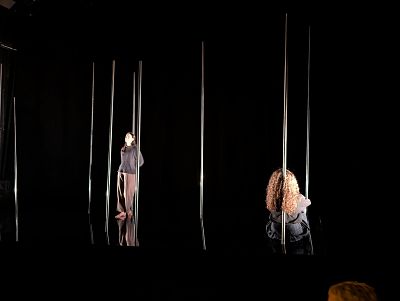
The stage is a tilted, mirrored plane designed by Harry Gill, who is known for a highly aesthetic and metaphor-driven approach to design. It is an unstable environment that forces the actors to constantly adjust their balance, mirroring the precarious nature of their lives.
Emma Choy (mother), Alpha Kargo (father), and Izabella Day (daughter) move through this space, physically blurring the line between acting and dance. They cross paths but never truly meet, creating a sense of three parallel lives that happen to share a roof.
Award-winning director Lyall Brooks manages the technical difficulty of the script with sharp precision. The three monologues run simultaneously, forcing the audience to choose which character to "hear" at any given moment. This creates a truthful but disorienting experience of how information is lost within a family.
The father’s struggle with depression, the mother’s quiet retreat into alcohol and jogging, and the daughter’s erratic fantasies regarding her teacher, Mr Young, are all laid bare, yet they remain invisible to the other characters on stage.
However, this structure is not without casualties. The auditory overload often results in "lost information," mirroring the family’s own breakdown but occasionally at the cost of the audience's grip on the narrative. This is most palpable during the father’s monologues; his harrowing "black dog" imagery, central to understanding his descent, can sometimes be swallowed by the competing voices of the mother and daughter. While this confusion is thematic, it risks transforming the viewer's empathy into frustration as they struggle to catch the vital fragments of his story through the noise.
The technical elements amplify this psychological pressure. Jack Burmeister’s soundscape uses low-frequency vibrations to build a physical sense of dread, while the recurring flood of red light provides a violent visual break from the family’s forced "normality." These moments of saturated colour are the only times the play allows the internal pressure to leak out.
Holloway’s prose is repetitive and circular, capturing the way a mind spirals when it has no outlet. A master of emotionally raw storytelling, Holloway first gained major attention with his 2007 play, Beyond the Neck, and later with his adaptation of the Australian classic Storm Boy. His work, which has earned multiple AWGIE Awards and the Victorian Premier’s Literary Award, is characterised by the "musicality" of language and the use of internal monologues.
In signature Holloway style, the play refuses to offer a "fix" or a moment of shared honesty. Instead, it ends exactly where it began: with the family performing the rituals of dinner and television while the storm continues to brew inside them. It is a stark, well-performed, and highly effective piece of theatre that succeeds by refusing to look away from the damage caused by silence.
Highlights
- Exceptional ensemble performance: Alpha Kargo, Emma Choy, and Izabella Day maintain intense emotional focus despite the complexity of overlapping monologues.
- Symbolic set design: Harry Gill’s tilted mirror serves as a powerful physical metaphor for a family "off its axis."
- Visceral technical direction: The use of sub-bass soundscapes and saturated red lighting translates internal mental states into a physical experience.
- Thematic disorientation: The use of simultaneous speech effectively places the audience inside the chaos of a fractured home.
Who It’s For
- Fans of psychological drama: Those who appreciate deep, character-driven studies of the human condition.
- Experimental theatre lovers: Audiences interested in non-linear storytelling and movement-based performance.
- Active viewers: People who enjoy "leaning in" to a performance, though be prepared for the mental fatigue that comes with tracking three stories at once.
Warning: Avoid it if you like conclusions or are triggered by themes of suicide and suicidal ideation, mental health struggles, alcohol use and dependency. The play has sexual references, course language, and reference to the use of a firearm.
Reviewed by Mary Sinanidis