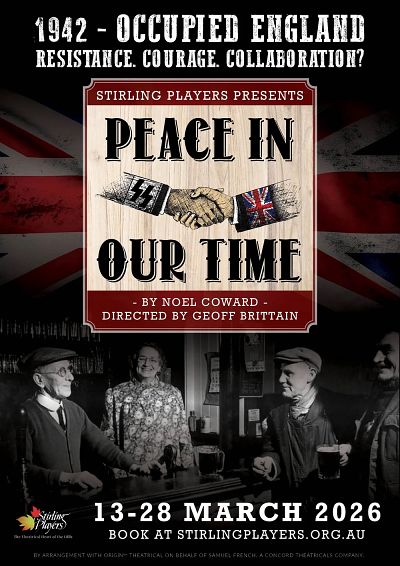
Peace in Our Time
Click here if you liked this article 7 
https://www.stirlingplayers.org.au/buy-tickets
Date Reviewed: 21/03/2026
On a beautifully warm autumn afternoon in Stirling, when sunshine and fresh air beckoned people outdoors, it was especially pleasing to see such a good audience turnout for this Saturday matinee of Peace in Our Time.
If you haven’t yet seen this little gem, it is well worth venturing up into the Hills this coming weekend for one of the final two performances.
Written in 1946 by Noel Coward, the play imagines an alternate history in which Nazi Germany has successfully invaded and occupied Britain. It is a sombre, unsettling work—far removed from Coward’s trademark comedies—and it probes the complicated ways ordinary people respond to oppression. Coward, fiercely anti? Nazi, who headed the British propaganda office in Paris until the city fell, it was during this period that the idea for the play took shape. It has been reported that Coward appeared on a Gestapo list of prominent figures to be liquidated should Britain have fallen.
As the audience enters the theatre, a faint smokiness lingers in the air, instantly conjuring the atmosphere of a well worn English pub. The set is richly detailed, convincingly lived-in, and beautifully realised. Throughout the performance, radio broadcasts and wartime songs drift through the space, anchoring us firmly in 1940s London—a world of 9:00 pm curfews, bread rations, and quiet acts of resistance woven into daily life.
Gill Cordell and Sandy Faithfull’s fabulous costumes add another layer of authenticity—and, for some of us, a touch of nostalgia. The knitted vests, ladies’ handbags, and headscarves are especially evocative.
The play introduces us to the pub’s regulars in Act I (set in November 1940), before moving forward into 1945 in Act II.
Alma Broughton is played with striking confidence and charisma by Annabel Whitford, while Linda Lawson brings intelligence and conviction to her close friend, the writer Janet Baird. My mother particularly loved Linda’s performance - for me, there were moments when Janet’s lines might have benefited from a slightly sharper, more acerbic edge.
Brendan Clare gives an excellent performance as Chorley Bannister, the editor of a highbrow magazine and a man all too ready to collaborate with the Nazi occupiers.
As Lyia Vivian the cabaret singer, Tegan Gully-Crispe is captivating, and Adam Schultz is equally strong as her devoted admirer, George Bourne. Lyia’s songs are a highlight—her voice carries the smoky, nostalgic quality of many beloved wartime vocalists.
Mr. and Mrs. Grainger—portrayed with gentle strength by Peter Bleby and Bronwyn Chapple—occupy their usual table in companionable silence, he with his newspaper and she with her knitting. Their dynamic feels instantly familiar, particularly when Mr Grainger repeatedly refers to his wife as “Mother”. Their quiet stoicism in the face of their son Billy’s fate—knowing only that he is being held in a concentration camp—adds a poignant undercurrent. Ky Speedy is a great Billy.
Publicans Fred and Nora Shattock, along with their daughter Doris—played by Tim Williams, Shelley Hampton, and Tianna Cooper—provide the emotional anchor of the production. All three are extremely believable. Tim Williams is particularly outstanding, and Tianna Cooper charts Doris’s growing confidence in her underground activities with subtlety and conviction.
Harri Wolff did Phyllis justice – excellent accent and portrayal of a young girl in her position. Kristin Stefanoff blended beautifully into the scenery as the old lady in rags, also playing the piano beautifully at key moments.
Sam Wiseman, Malcolm Walton, Sebastian Hollingworth, and Clinton Nitschke completed the ensemble, and I could not fault any of them – the cast worked together with impressive cohesion.
Congratulations to director Geoff Brittain for staging an immersive and moving production.
Peace in Our Time is a thought-provoking piece — one that still resonates powerfully eighty years after it was written.
Reviewed by Deb Secombe