Nai-iba - The Other: A Look at Medea
Click here if you liked this article 105 
https://www.theatreworks.org.au/2026/na-iba%3A-the-other%2C-a-look-at-medea
Date Reviewed: 17/10/2026
Reviewed by Mary Sinanidis
It was the word Medea that drew me to Roman Berry's Na-iba – The Other: A Look at Medea. I expected a retelling of the notorious mother who murders her children in one of Greek tragedy's most disturbing acts of revenge.
As a Greek, I was curious to see what another culture would make of Euripides' heroine. Admittedly, my inner guardian of Greek mythology was on alert. Instead of cultural appropriation, however, I encountered seven women telling stories of their own. Unexpectedly, I recognised something of myself in them.
Presented by Divergent Theatre Collective at Theatre Works' Explosives Factory for Melbourne Fringe, Na-iba is a work-in-development exploring the ancient tragedy's themes of exile, rejection, identity and belonging.
In Filipino, na-iba means different, or the other. As Berry explains: "It is not a word you give yourself. It is a word someone else gives you."
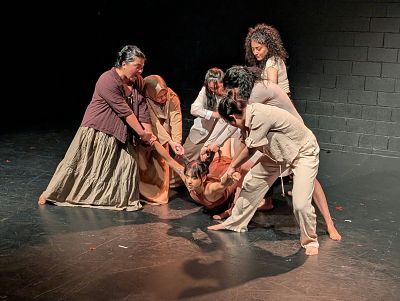
Seven women with connections to the Philippines, India, Malaysia, Chile, Vietnam and Iran explore what it means to be judged, excluded or defined by others.
Their stories are disarmingly familiar: a woman pretending to be happy and fit in when she is anything but; a volunteer judged for her appearance rather than her willingness to help; a 40-year-old woman questioned for being unmarried and childless. Everyday acts of othering easily dismissed but capable of leaving lasting scars.
The result is intimate, occasionally uncomfortable but always compelling. What struck me was the performers' vulnerability. Rather than disappearing behind fictional characters, they seemed to reveal themselves, shifting our attention from a mythical outsider to women we encounter in our workplaces, communities and families.
During the post-show discussion, I remarked, "It seems like therapy." The performers nodded emphatically. Their response reinforced the impression that this was as much a process of personal discovery as a theatrical production.
The production's greatest strength, however, was its physical storytelling.
Director Berry draws on a devising methodology rooted in Tinikling, a Filipino folk dance. The transitions between monologues were exceptional. The performers moved, danced, paused and regrouped with infectious energy, combining discipline with spontaneity. There was joy in their movement, even when their stories were painful.
Their bodies expressed what words sometimes could not: the tension between individuality and belonging, the desire to fit in and the struggle to retain one's identity.
Yet the episodic structure exposed the work's limitations. While individual stories resonated, they did not always build towards a cohesive dramatic argument. The connection to Medea occasionally felt more like a starting point than an integral part of the performance.
After all, Euripides' heroine is not simply a woman rejected by society. She is also capable of horrific violence. Her story confronts betrayal, power, motherhood, revenge and the limits of sympathy.
Did Euripides condemn Medea or give a foreign woman a voice in a society that feared her? His heroine is both victim and perpetrator, outsider and agent. These contradictions have kept audiences arguing for almost 2,500 years.
Na-iba shifts the question from what an outsider might do to what society does to outsiders. It is a worthwhile interpretation, although a deeper engagement with Medea's moral contradictions could give the work greater dramatic depth.
This is, of course, a development showing rather than a finished production. Berry describes it as "unfinished and still breathing". Further development could bring the personal stories into closer dialogue, allowing performers to challenge and respond to one another rather than relying so heavily on successive monologues.
And, while we're making suggestions, why not introduce women from communities divided by historical or political conflict? Greek and Turkish, Israeli and Palestinian perspectives could add another layer to the exploration of inherited prejudice, identity and belonging, and ways to bring peace through the exploration of our shared humanity (provided the women were able to speak on their own terms rather than represent entire communities).
I arrived just as the lights dimmed, missing my customary opportunity to survey the audience for clues about what awaited me. When the lights came on again, I noticed a few empty seats and a culturally diverse audience that, much like the ensemble, appeared to include many people from migrant backgrounds.
I was disappointed, not by who was there, but by who wasn't.
A production confronting prejudice and exclusion deserves to reach beyond audiences who already recognise these experiences. At a time when extremist rhetoric and anti-migrant sentiment are increasingly visible, its greatest impact could lie in challenging people who have never considered how their words or assumptions might make someone else feel like an outsider.
I'd happily offer a few complimentary tickets to One Nation candidates, and give Pauline Hanson a front row seat. Consider it an exercise in empathy.
Ironically, the small audience made the post-show discussion one of the evening's highlights.
Rather than a conventional question-and-answer session, Berry facilitated an open exchange between performers and audience. The intimacy of the Explosives Factory dissolved the usual separation between stage and auditorium, making the conversation an extension of the performance.
In his director's note, Berry had promised: "Medea never got a room that held her. Tonight we try to build one."
It was during this discussion that his intention became clearest. The performers were not simply being watched or judged. They were being heard, and the audience was invited to participate rather than merely applaud the ensemble made up of Mayen Estanero, Isha, Nurul Aida Mohammad Zaffir, Alecx Keanne Barredo, Mariabelen Bernal Villalón, Linda Nguyen and Denli Chavez.
“I was a chemical engineer,” one of the performers said, “Maybe I can be one again someday.” Another said, “I was a geologist.”
I asked them about this use of past tense - was - and why they no longer identified as such. "You're still a chemical engineer," I observed.
For me, this discarding of the women’s identities both in the play and in the discussion, was the unexpected connection to Euripides. I arrived protective of a Greek story and left reflecting on how readily we recognise ourselves in stories from other cultures.
Perhaps that is the value of reinterpreting ancient mythology. The stories need not remain exclusively Greek to speak to us, provided their retelling reveals something worthwhile.
Na-iba is still finding its dramatic shape. Its ensemble movement is stronger than its narrative structure, and its ideas deserve further theatrical development. But its authenticity, physical inventiveness and willingness to open difficult conversations make it unique and promising.
I went expecting Medea, the child-killer.
I stayed for seven women determined to tell their own stories.
And perhaps that is where a new conversation about Medea should begin.
Highlights
- Authentic, vulnerable storytelling drawn from lived experiences.
- A culturally diverse ensemble bringing different perspectives to the stage.
- Exceptional movement and choreography, particularly the transitions between monologues.
- An intimate post-show discussion that became part of the theatrical experience.
- A thought-provoking concept with potential for further development.
Who's it for?
Anyone interested in contemporary theatre, Greek mythology, migration, identity and the politics of belonging. Particularly rewarding for those who enjoy experimental, movement-based performance and theatre that invites discussion rather than offering easy answers.
But perhaps the people who most need to see it are those who don't think it's for them.