Masterpieces of the Oral and Intangible Heritage of Humanity
Click here if you liked this article 18 
https://www.theatreworks.org.au/2026/masterpieces
Date Reviewed: 25/07/2026
UNESCO defines "oral and intangible heritage" as "the totality of tradition-based creations of a cultural community... recognised as reflecting its cultural and social identity."
American playwright Heather McDonald's Masterpieces of the Oral and Intangible Heritage of Humanity strips away the bureaucratic jargon of UNESCO’s definition and distils it into a single, haunting question: when civilisation crumbles, what is worth saving?
Directed with powerful precision by award-winning director Nadia Tass at Theatre Works, this Australian premiere explores that question through a masterclass in contrasts: tenderness beside brutality, beauty beside destruction, hope beside despair, laughter alongside grief.
The play’s ironies are as devastating as they are darkly funny, inviting uneasy laughter that catches in the throat. A museum built to preserve history becomes a prison, and art created to celebrate humanity becomes evidence of humanity's failures. Every irony lands with force.
Without missing a beat, Layla breaks from her role as tortured prisoner and addresses us as though we are students attending one of her lectures. It feels so real that when latecomers arrive, she ushers them in as naturally as an impatient professor about to lecture at a university auditorium. She asks: “Imagine your home is on fire. You have one shoebox and twenty minutes. What do you save?”
I panic, mishear the instructions, think she is talking about humanity in general, and for some reason scrawl "Plato's Republic" (but why?) on a piece of paper I've been given. My theatre companion scribbles something about "an ornate glass bottle" – or words to that effect.
It's a deceptively simple exercise that immediately reframes the evening, and suddenly we're already questioning what gives our lives meaning.
Only then does McDonald transport us into the play’s war-ravaged world, where those questions become terrifyingly real during a 100-year war.
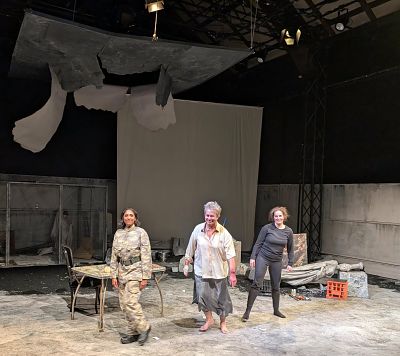
The play centres on three women trapped inside a bombed museum turned makeshift prison.
Layla (Jane Montgomery-Griffiths), an internationally respected art conservator, has been captured while lecturing on cultural preservation. Ordered to restore a damaged Rembrandt for the regime, she refuses. To restore beauty while children are being murdered would make her complicit, she says. Still, she would like to see the painting of the ‘Two Maries’.
Mitra (Kate Cole), a soldier almost entirely shaped by violence, is terrifying without ever becoming monstrous. Like Layla, she is another victim of endless war, clinging to obedience because it's all she's ever known.
The third woman, Nadia (Laila Thaker), is a grieving Muslim mother abducted from a hospital after being mistaken for a nurse. Her desperate search for her missing daughter strips away every social convention.
What makes McDonald's writing so remarkable is its refusal to offer easy moral binaries. There are no saints or villains here. Each woman has caused harm, suffered immeasurable loss and carried impossible burdens. There is goodness in all three, just as there is damage in all three. They are not symbols but fully realised human beings trapped inside a machine that destroys everyone it touches.
The performances capture those subtleties beautifully.
Jane Montgomery-Griffiths anchors the production with extraordinary intelligence, wit and restraint. Layla's courage is never performative; it lives in quiet moral certainty, dry humour and an unwavering refusal to surrender her principles. It's impossible to imagine anyone else inhabiting the role. In fact, it’s hard to believe Jane is anyone but Layla even outside the role.
Kate Cole resists every cliché of the ruthless soldier. Beneath Mitra's military precision flicker loneliness, curiosity and vulnerability. When violence erupts, it is all the more horrifying because it comes from someone whose humanity has been systematically eroded rather than erased. In a genius twist, it is only when she loses her sight that she begins to see.
Laila Thaker gives Nadia a raw, instinctive desperation. Her grief is almost animalistic, yet she never loses the warmth that reminds us she is, above all else, a mother searching for her child.
Together, the three women discover common shards of humanity as they reveal the play's greatest truth: nobody escapes war unchanged.
One of the evening's most chilling exchanges comes during an interrogation.
MITRA: "I could smash your head and gouge out both of your eyes."
LAYLA: "You could."
MITRA: "Then it would be difficult for you to do your work."
LAYLA: "Restoration is always difficult."
In these four lines, McDonald encapsulates the entire play. One woman understands only destruction, while the other insists restoration remains possible even when the cost is unbearable.
The production's most moving image arrives near the end, returning us to that opening exercise. During an escalating bombing raid, the audience's handwritten "masterpieces" drift from the ceiling like fragile snow. As Layla reads them aloud, strangers' treasured memories become acts of quiet resistance.
By then, I regret writing "Plato's Republic".
Instead, we hear about a song that recalls a seven-minute kiss. Nina Simone and Elvis records. A grandmother whose stories always began, "First, we ran out of gin." Ancient Tibetan bowls repaired through kintsugi, becoming "more beautiful, more valuable for their brokenness."
A child's entirely yellow drawing of God. Told nobody knows what God looks like, she replies: "Well, they will soon."
A prisoner knitting tiny jumpers for birds because "they've forgotten how to fly."
These are the true masterpieces.
McDonald's central argument is profound: culture doesn't survive because museums protect it. It survives through memory, humour, ritual, love and ordinary people who refuse to forget.
The set design by Ishan Vivekanantham reinforces that idea beautifully. The shattered museum of broken beauty feels simultaneously like a sanctuary, a prison and a graveyard for civilisation, allowing the emotional weight of the performances to dominate while constantly reminding us of what has already been lost. The random rhinoceros is a surprise, always lurking somewhere. “Is it to symbolise strength and resilience?” I wonder, trying to make sense of it.
Poetic and deeply humane, Masterpieces of the Oral and Intangible Heritage of Humanity is one of the year's essential theatre experiences. Heather McDonald's extraordinary script refuses simplistic notions of good and evil, revealing that war creates victims on every side. Everyone is diminished by conflict, yet McDonald does not confuse victimhood with moral equivalence. As Layla reminds us with devastating clarity: "If you find yourself hurting children in a school, you're probably on the wrong side."
The play leaves us with a question that lingers long after the curtain falls: when history is erased, who remembers what made us human?
By the final blackout, the answer is clear. We are human not through monuments or masterpieces hanging in galleries, but through stories, songs, memories and the people we refuse to forget.
Highlights
- Can we please take a moment here to appreciate the play’s cool title?
- Great cast but Jane Montgomery-Griffiths delivers a stand-out, unforgettable performance.
- Heather McDonald's script is intellectually rich, emotionally devastating and full of surprising humour. It respects you enough to be political without telling you what to think, allowing you to draw your own conclusions.
- Nadia Tass directs with remarkable precision, balancing horror with hope.
- There’s even a random rhinoceros.
- Atmospheric lighting by lighting designer David Parker (Tass’ partner) and sound design by Daniel Nixon create an immersive, haunting world.
- The production will stay with you long after you leave the theatre, with questions about our own humanity, and you may even find yourself looking for Rembrandt's "The Two Marys".
Who’s it for?
Anyone who loves theatre that provokes as much as it moves. Ideal for thinkers, lovers of literature and history, museum-goers, and anyone interested in how art, memory and humanity endure through conflict.
'Masterpieces of the Oral and Intangible Heritage of Humanity' runs at Theatre Works (14 Acland Street, St Kilda) through to 1 August, 7.30pm every evening (except Sunday and Monday).
Reviewed by Mary Sinanidis
P.S. Since the show, I've kept returning to that opening question. If I had one shoebox and twenty minutes, I no longer think I'd reach for a book, not Plato, not the Bible, Quran or Bhagavad Gita. I'd fill it with photographs, handwritten letters, my daughters' childhood drawings and locks of hair from their first haircut, and the small, ordinary objects that carry the people I love. The play made me realise that our greatest masterpieces aren't the things we own. They're the memories that would vanish if we didn't carry them with us.