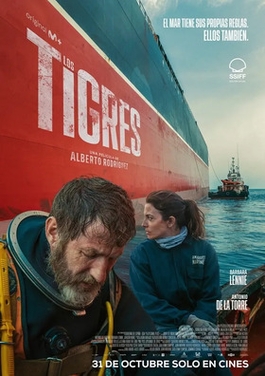
Los Tigres | HSBC Spanish & Latin American Film Festival at Palace Cinemas Melbourne
Click here if you liked this article 4 
https://spanishfilmfestival.com/
Date Reviewed: 06/06/2026
Film Review: Los Tigres | HSBC Spanish & Latin American Film Festival at Palace Cinemas Melbourne
Some films create tension through noise, speed and spectacle. Los Tigres does the opposite. Its most gripping moments unfold in near-silence, deep underwater, where visibility is poor, danger is constant and every breath feels borrowed. From its opening scenes, Alberto Rodríguez's latest film pulls the viewer into a world where physical risk and emotional pressure are impossible to separate. Screening at Palace Cinemas Melbourne as part of the HSBC Spanish & Latin American Film Festival, Los Tigres is a taut, atmospheric crime drama with real human weight behind it.
Rodríguez, the Andalusian director best known for the acclaimed Marshland (2014), sets the story in Huelva, around the petrochemical port where siblings Antonio and Estrella work as experienced divers. It is demanding, dangerous work, and the film makes that clear without overstating it. When Antonio's health begins to fail and financial pressure threatens his ability to support his two daughters, he and Estrella are drawn into a risky plan to steal drugs hidden in the hull of a docked ship.
On paper, the premise sounds like a straightforward thriller. In Rodríguez's hands, it becomes something richer and more unsettling. Los Tigres is not just about crime, but about what people do when they are cornered. It is about loyalty, desperation and the difficult choices that arise when love and survival start to blur.
Antonio de la Torre gives Antonio a quiet, weathered dignity. He is clearly unwell, financially trapped and making decisions that could destroy him, yet the film never asks us to see him as foolish or reckless. His choices may be dangerous, but his reasons are painfully clear. His devotion to his daughters gives the film its emotional pull, turning what could have been a simple crime story into a moving portrait of a father under impossible pressure. Antonio is flawed, but that is what makes him believable. His determination is what makes him so compelling.
Bárbara Lennie is equally impressive as Estrella, and in many ways she becomes the film's emotional anchor. Tough, sharp and fiercely loyal, Estrella is a character who does not need grand speeches to command attention. Lennie brings her a wonderful mix of strength, humour and vulnerability, particularly in the scenes she shares with Antonio. Their sibling relationship is the heart of the film: built on shared history, old loyalties and the kind of unspoken understanding that only comes from a lifetime together. As the danger around them grows, that bond becomes more important than ever.
The underwater sequences are among the film's greatest strengths. Pau Esteve Birba's cinematography makes the diving scenes feel dark, claustrophobic and deeply immersive. The film received a Goya nomination for Best Special Effects and went on to win the award, and it is easy to see why. These scenes are not presented as beautiful or serene — the water is murky, heavy and unforgiving, a place where things can go wrong quickly and silently. Rodríguez and Birba make the audience feel every metre of depth, every moment of uncertainty and every second of held breath.
The supporting cast adds further texture to the world of the film. Joaquín Núñez and César Vicente, as Nico, help flesh out the dangerous network surrounding Antonio and Estrella, while the other divers and peripheral figures of the criminal world give the story a lived-in authenticity. Julio de la Rosa's score plays an equally important role, building tension without overwhelming the quieter moments. Even when very little appears to be happening on the surface, the music keeps a current of unease running underneath.
If the film has one weakness, it is that the ending comes a little abruptly. After such careful pacing, the final stretch feels slightly too sudden, as though the story has more to say. At the same time, that lack of neat resolution may be entirely deliberate. Rodríguez is not interested in easy endings, and Los Tigres is a film about people living in circumstances where closure is rarely simple. Still, it leaves you wanting more — and if the story were to continue, there would certainly be an appetite for it.
Los Tigres premiered at the 73rd San Sebastián International Film Festival to strong notices, and its Australian screening through the HSBC Spanish & Latin American Film Festival feels well deserved. It is a tense, beautifully crafted and deeply human thriller — one that understands that the most powerful danger is not always found in the crime itself, but in the reasons people feel they have no choice but to commit it.
The HSBC Spanish & Latin American Film Festival continues at Palace Cinemas Melbourne through July 2026. Full programme details are available at palacecinemas.com.au.
Reviewed by Anushka