Little Absences
Click here if you liked this article 8 
https://chapeloffchapel.com.au/show/little-absences/
Date Reviewed: 19/03/2026
Hindsight is 20/20. Reflecting on my evening after watching Little Absences at The Loft, I found myself wishing I had skipped the theatre altogether to visit an elderly relative instead. It wasn’t because the play was lacking, but because it was so uncomfortably, piercingly real.
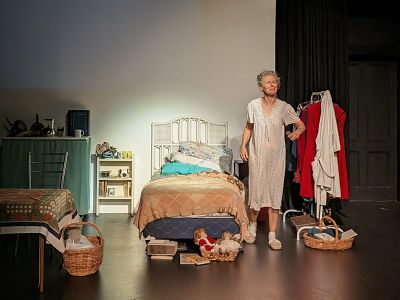
The immersion begins the moment you step through the black door that opens directly into sleeping grandmother’s sanctuary. You quietly walk past her bed to take your seat and wait for morning light (in our case, we went through this three times due to technical issues).
The production is a slow-paced, atmospheric journey centred on Chris, a keenly intelligent and fiercely independent woman navigating the twilight of her life. Played by Janet Watson Kruse, Chris wakes up to chirping birds, moving frailly in a stained robe among piles of books and newspapers from god-knows-when. She battles the creeping fog of dementia and a lingering dependency on alcohol, her world grounded by a ticking clock that serves as a constant, auditory reminder of passing time.
Throughout the play, as Chris becomes frailer, the set also seems to "unravel” and the mess gets larger as she walks from room to room, leaving a trail behind her. Chris feels body aches and does a lot of what specialists call "resourceful walking", a term acknowledging that her movement isn't aimless, but a search for a person or place from her past.
Through conversations with her late husband, Frank, a life only half-lived comes to light. We discover that Chris is a "repressed poet" stifled by societal constraints, sharing verses she never published and memories of being told to "get back to work" when she dared to complain of sexual harassment.
The play’s strength lies in the discovery of Chris’ hidden history. A large video wall playing images while Chris sleeps add a cross-disciplinary layer, immersing us in the "spirit of her life." This perfectly encapsulates the thesis of the "small deaths of words once known," as Chris notes in a poem written when her own mother was aging: "It starts with little absences... It sneaks and creeps... until confusion is."
Kruse is nothing short of divine, capturing the "innocence of youth" hidden within a weathered exterior. Her portrayal of Chris’s defiance, insisting she can look after herself even as she forgets the time of day, is heartbreakingly authentic.
Piera Dennerstein provides a strong emotional counterpoint as Jenny, the daughter torn between love and the exhausting fear of her mother's vulnerability. Veronicka Devlin rounds out the cast as Alex, a writer who enters Chris’s life after a bike accident. While the character at times feels like a vessel for exposition, Devlin brings a necessary softness to the role.
Despite the great acting, Little Absences is "untidy," refusing to offer easy answers or a tidy plot. The realism is so thick and repetitive that you may catch yourself feeling impatient, and then you realise that’s the point.
The play forces you to confront why you might avoid visiting that elderly aunt whose self-care has slipped, or why we often look away from the slow-motion struggle of aging. By forcing us to sit in that discomfort, the play becomes more than just a performance; it is a vital platform for the immense talent of older women artists who remain underrepresented on our stages.
We need more interesting characters for mature actresses to perform. In this role, Kruse proves that artistic power has no expiry date.
Highlights
- Exceptional Ensemble: Powerful, grounded performances across the board that find the humour in the heartbreak.
- Immersive Visuals: The video wall elegantly bridges the gap between Chris’ physical frailty and her vivid, soaring dream sequences.
- The "Sonic" Set: The use of the ticking clock and ambient sound creates an almost claustrophobic sense of time slipping away.
Who is it for?
- The ‘sandwich’ generation: Those currently balancing the care of aging parents with the demands of their own lives will find deep, painful resonance here.
- Poetry and literature lovers: For those who appreciate how words can both define a life and be the first things to disappear.
- Social Realism Fans: Anyone who prefers "uncomfortable truths" over easy, theatrical resolutions.
Reviewed by Mary Sinanidis