Life is Life
Click here if you liked this article 2 
https://italianfilmfestival.com.au/films/iff26-life-is-life
Date Reviewed: 05/09/2026
Life is Life: Italian Film Festival
Riccardo Milani’s Life is Life, is a modest film that wrestles with deep questions: What is the price of principle? Can integrity withstand the slow erosion of economic pressure and social consensus? Inspired by a true story, Milani sidesteps the tired conventions of the underdog legal drama, opting instead for a meditative, almost anthropological portrait of resistance. The film’s boldest gamble is its transparency as we know that Efisio Mulas will not sell his ancestral land. The tension, then, is not if he will hold firm, but how, and at what cost to his soul and his community.
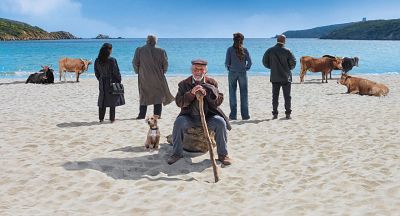
Milani’s visual language is exquisitely calibrated to this thematic divide. The film opens with a lingering long shot of Efisio’s back, a silhouette of weathered brown jacket and herringbone cap against the untouched coastline of southern Sardinia. It is a composition of profound solitude, one that immediately establishes the land as an extension of the man himself. The director cuts with surgical precision between these sprawling, sun-bleached landscapes and the claustrophobic, glass-and-steel interiors of Milanese corporate power, capturing a clash not merely of interests, but of entire world views.
At the heart of the film is a performance the remarkable Giuseppe Ignazio Loi, whose weathered face and sparse dialogue carry the weight of decades. His Efisio is no caricature of stubbornness. He is a man of few words because he has no need for excess. His "no" becomes a mantra that grows in comic resonance as the real estate offers escalate and the townspeople line up to persuade him to accept the property giant’s proposal. Yet the humour, which earned the film the Best Comedy award at the Nastro d’Argento, isn’t the laugh out loud type, it' the quiet charm that emerges from watching a fourth-grade-educated shepherd outlast an army of lawyers, developers, and well-meaning neighbours. The screenplay wisely avoids villainy; Aldo Baglio’s construction manager is less an antagonist than a soul wrestling with his own choices, and Diego Abatantuono’s corporate president, Giacomo, is afforded moments of genuine bewilderment of how a shepherd refuses to give in to the machinery of capital.
Where Milani excels is in his refusal to settle for easy dichotomies. The subplot involving Virginia Raffaele’s Francesca, the daughter caught between filial loyalty and the pragmatic pressures of her community introduces a necessary generational friction. Her conflict is not melodramatic but painfully real, and Raffaele conveys it with a raw, understated force that grounds the film’s more philosophical ambitions. The film does not pretend that Efisio’s stance is without collateral damage; it acknowledges the social cost of unbending virtue, even as it celebrates its necessity.
Thematically, Life is Life is a meditation on inheritance in its truest sense beyond land. It’s the values, memory and identity we choose to instill in the next generation. This is most obvious when Milani juxtaposes Giacomo imprisoned behind his corporate glass while Efisio swims freely in the sea with joyful laughter. Milani leaves us with a poignant, unanswered question: can the next generation inherit this courage or will pursuit of wealth erode what Efisio so unshakably fought for.
Life is Life is a quiet narrative that trades explosive conflict for sustained moral inquiry. It is a work of profound determination, anchored by a director who trusts his audience to find the drama in a man’s unwavering gaze. In an era of spectacle and cynicism, Milani has crafted a fable of quiet heroism that lingers after the screen fades to black, a reminder that sometimes the most radical act is simply to stay rooted.
Review by Sandra Lee