Jeremy Moses is hard to work with
Click here if you liked this article 6 
Date Reviewed: 29/03/2026
There’s something deliciously unhinged about Jeremy Moses Is Hard to Work With. It’s a show that feels like it might fall apart at any second, and yet that’s exactly its strength.
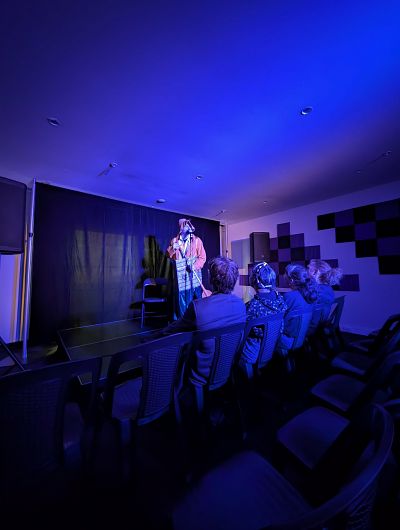
You’re greeted at the door by Jeremy Moses himself, already half in character, half in apology, like a host who’s both thrilled you came and slightly suspicious of your intentions. “Sit as close as you can to the stage,” he asks. “I promise I won’t pick on you to do things.”
Inside, the room is… intimate. Six people, give or take. One of them is a rogue comedian from another show hustling flyers for Dr Duck like it’s the Edinburgh Fringe hunger games. The vibe? Awkward, scrappy, weirdly perfect.
From the jump, Moses leans into a kind of chaotic, self-deprecating awareness. The jazz hums in the background, and somewhere in the mix, lyrics land like a passive-aggressive Google review: “Jeremy Moses is hard to work with.” It’s not just a line but the thesis, the joke, the wound, and the punchline all at once.
Born legally blind, Moses has carved out a singular space in the Australian comedy scene, performing on fringe stages, festival circuits, and on social media, steadily building a following that doesn’t quite know what hit it until it does.
There’s a looseness to his performance that feels earned. His comedy is shaped by his visual impairment but never confined by it: elastic face, loose limbs, big swings. He moves like someone who refuses stillness, even as he occasionally fumbles through the dark between costume changes, turning disorientation into part of the act.
There are puns (so many puns), but also something stranger at play: jokes that don’t quite land in the traditional sense. And that’s where it gets interesting. Often, the laugh arrives in the absence of a punchline. You lean forward, expecting the turn, and instead get something flat, literal, almost banal, and your brain short-circuits.
Moses flirts heavily with anti-humour (that “so bad it’s good” edge) but not by accident. This is cringe with intent. Dad jokes delivered with absolute conviction. A performer who might be a genius or deeply irritating, sometimes within the same breath, and somehow aware enough to weaponise both.
And then it tilts further into the absurd.
There’s an AI voice threaded through the show as part accessibility tool, part antagonist, part existential narrator. It doesn’t just describe; it critiques, embellishes, undermines. It’s sharp, funny, occasionally brutal. A puppet fish appears too: infantile, surreal, faintly unsettling. For a moment, you think you’ve stumbled into a children’s show until the fish asks for a wet kiss, with tongue.
None of this should work, but the dynamic between the blind comedian and the deaf fish becomes, bizarrely, the emotional core. Though ridiculous, it is also oddly tender.
Moses has spoken about wanting to explore disability in ways that feel playful, open, and honest, and here it is: messy, irreverent, and disarmingly human. The show carries a faint old-school variety energy too with sketches, monologues, even flashes of vaudeville-style performance that feel both nostalgic and chaotic.
Underneath the chaos is something more personal. Moses draws on a life shaped by a rare condition affecting his sight and coordination, folding in awkward misadventures, creative friction, and the sting of being told, repeatedly, that he’s “hard to work with.” There’s humour in it, but also a quiet insistence on being seen on his own terms. Not as a punchline, but as a perspective.
What he does, at his best, is push “unfunny” so far it loops back into something like high art. There’s real craft buried in the mess—timing, structure, call-backs, all disguised as disorder.
And then there’s the venue: Trainscendence. As though a kid took a shoebox and built a dream world out of disco ball glitter, scrap metal and imagination. Rooms filled with upcycled knick-knacks, colour-coded spaces, transport-themed whimsy. You start at Platform Infinity, a train station café.
We didn’t make it to the rooftop train carriages for this performance, but honestly, we didn’t need to. A man arguing with an AI and romancing a fish already feels like it belongs in a train in the sky. Trainscendence doesn’t just host the show, it amplifies it. It mirrors the whole experience: a little scrappy, a little surreal, unexpectedly thoughtful.
Jeremy Moses Is Hard to Work With isn’t a clean night of comedy. It’s jagged, unpredictable, occasionally frustrating and melancholy, but also very, very funny. You might leave wondering whether you witnessed brilliance or bedlam.
Chances are, it was both.
Highlights:
- Jeremy’s deceptively soothing voice cutting through the chaos
- The recurring soundtrack whispering “Jeremy Moses is hard to work with” like an inside joke you’re suddenly in on
- The way he turns disability into both material and method—never tokenistic, always owned
- The AI narrator and puppet fish: bizarre, confrontational, and strangely affecting
- The Trainscendence venue, which feels like stepping into someone else’s imagination
Who’s it for?
Anyone who likes their comedy a little left of centre—fans of anti-humour, Fringe chaos, meta-theatre, and performances that blur the line between bomb and brilliance. Not for those chasing clean punchlines; absolutely for those who enjoy the weird, the uncomfortable, and the unexpectedly profound.
Reviewed by Mary Sinanidis