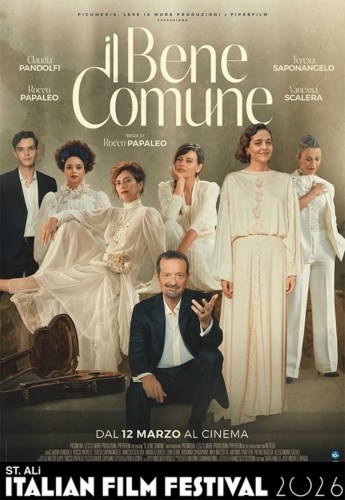
Italian Film Festival 2026 | The Greater Good
Click here if you liked this article 0 
https://www.palacenova.com.au/films/iff26-the-greater-good
Date Reviewed: 15/09/2026
A thoughtful opening establishes the intriguing style of The Greater Good. Retired army officer Biagio runs tours in southern Italy, assisted by his nephew, who spends his spare time training as a runner. When Biagio is asked to lead a hike to a Bosnian Pine, supposedly the oldest living tree in Europe, his group consists of five female inmates from a low-security detention house and their drama workshop leader, Raffaella, a struggling actress.
Biagio is cynical about most things, but seemingly justified in this outlook, particularly considering his previous life. This is best shown through his scepticism towards religion, which becomes one of the film’s quieter ways of exploring his relationship with the world around him. There is something distinctly familiar in the ideas explored by The Greater Good. Its romanticisation of summer, relaxed approach to living and vaguely cynical perspective on life all emulate some very Australian ideas. The nature is also incredibly beautiful, giving the film a strong sense of place.
The soundtrack is superb at maintaining the film’s pacing, while the humour is clever and understated. It does not seek to dominate the screen with verbose or absurd comedy, instead allowing its characters and situations to generate the humour naturally. The changeable nature of life is portrayed in beautiful detail, before occasionally cascading into quite shockingly dark territory.
The film’s broken narrative works well, particularly in the way we slowly discover the backstories of its characters. The school bus becomes a clever metaphor for these prisoners re-educating themselves to the rest of the world, while the way the “girls” and men intersect throughout the journey is handled particularly well.
But there is an unusual kind of restraint to The Greater Good: an insistence on conventionally toying with enormous ideas rather than plumbing them to their depths. It lacks the unique colour that these kinds of person-centred pieces require. The characters can verge on caricature: the naïve singer, the suffering actress, the driven athlete, the snarky hacker of colour. Slowly revealing their backstories is an effective technique, but the film does not always give these characters enough complexity to move beyond their initial types.
I should confess that I read a previous review comparing the film’s techniques to The Canterbury Tales, a book I have in the past perused. To make that comparison convincing, I think I needed a stronger thematic through-line. Some elements of the story feel more like narrative coincidence than a sustained exploration of life.
Theatre as a healing element in prison life is explored, but perhaps not fully understood in the way the Australian film Cosi explores theatre as a form of connection for mental patients. The musical elements also begin to fit somewhat clumsily as the narrative develops. The live music is fine, but fails to provide the window into the psychology of these colourful female characters that I wanted.
The film shifts towards melodrama at certain points, and it was here that I realised my enjoyment had begun to decline. While the humour did make me laugh, it sometimes undercuts the realism of the characters and narrative. The ending feels honestly absurd and almost ruins the tone established by the film so far.
The Greater Good is an intelligent and beautifully paced film, with a superb soundtrack and some genuinely beautiful observations about life and nature. But its restraint ultimately prevents some of its more interesting ideas from developing, while the increasingly awkward musical elements and melodramatic ending leave it feeling less cohesive than it initially promises.
Reviewed by Nic