Interview: Art director Spiro Economopoulos sits with us in the dark at Europa! Europa
Click here if you liked this article 6 
https://www.europafilmfestival.com.au/
Date Reviewed: 02/03/2026
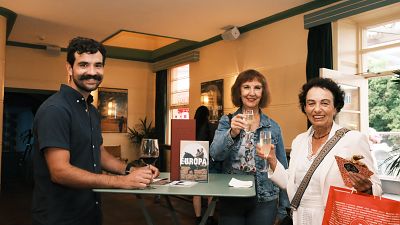
On opening night at the Lido Cinemas in Hawthorn, Spiro Economopoulos stood before a packed house and made a simple case for why festivals matter: in a fragmented, distracted age, “sitting together in the dark still means something”.
As artistic director of the Europa! Europa Film Festival, he has curated 43 films from 22 countries, screening from February 19 to March 19 across Melbourne and Sydney, and, for the first time, Brisbane, Hobart and Auckland. The program reflects a Europe in flux, shaped by migration, conflict and shifting identities, but also alive with formal daring and emotional risk.
A former Program Director of the Melbourne Queer Film Festival and longtime programmer at the Australian Centre for the Moving Image, Economopoulos has built his reputation on trusting audiences to embrace nuance, and even division.
He spoke about the festival’s fifth edition, about transformation, brave cinema and the collective intake of breath before a film begins.
He told It’s On the House that audiences are braver than what we give them credit for and his 2026 reflects this belief, offering a glimpse into Europe in flux, shaped by migration, conflict and shifting identities, and a commitment to cinema that is bold, personal and unafraid to divide opinion.
Was there a particular film or moment that made you realise cinema would be your life?
There wasn’t one lightning-bolt moment. It was more cumulative. Growing up between cultures, European cinema felt like a mirror and a window at the same time. I remember watching films as a teenager and realising film could hold contradiction... humour and tragedy, politics and intimacy... all in the same frame. That complexity stayed with me.
The festival takes its name from Europa, whose story is about crossing borders and transformation. Do you see European cinema in 2026 in a similar moment of transition, shaped by migration, politics and shifting identities?
Absolutely. European cinema has always been shaped by movement of people, of language, of ideas.
In 2026, that feels heightened. Migration, war, generational change, identity politics, these are not abstract themes, they are lived realities. What’s interesting is how varied the responses are. Some films confront these shifts head-on; others explore them through family stories, genre cinema or even comedy. Transformation is constant, and cinema reflects that.
Europe is facing war, migration crises and political polarisation. Are filmmakers confronting those tensions directly, or responding in more oblique and unexpected ways?
Both. There are bold political works that tackle conflict and displacement very directly. But I’m equally drawn to films that approach these tensions obliquely; through love stories, thrillers, or intimate character studies. Sometimes the most powerful political statement is a quiet one.
European filmmakers are very skilled at embedding big questions inside deeply personal narratives.
After eight years at the Melbourne Queer Film Festival, what have you carried into your role at the Europa! Europa Film Festival? Has programming queer cinema changed the way you approach storytelling more broadly?
Programming queer cinema teaches you to value perspective. It sharpens your sensitivity to whose story is being told, and how. At MQFF I learned the importance of platforming voices that sit outside the mainstream and of trusting audiences to engage with nuance. That absolutely informs how I curate Europa! Europa. It’s not about ticking boxes; it’s about ensuring the festival reflects the richness and plurality of European storytelling.
Do you program with the audience in mind first, or do you trust the films to find their audience?
It’s a dialogue between the two. I’m always thinking about our audience, what they're curious about, and what their appetite is for discovery. But I don’t program defensively. I trust that if a film is bold, distinctive and emotionally truthful, it will connect. Festivals are spaces of discovery. Audiences come ready to be surprised.
Why open with The Testament of Ann Lee? What does that film signal about the kind of festival you want to curate?
The Testament of Ann Lee is formally daring and spiritually searching. It interrogates faith, belief and community in a way that feels both historical and urgent. Opening with that film signals that we are interested in cinema that takes risks, aesthetically and philosophically. It invites audiences into a festival that values ambition and depth.
What’s the bravest film in this year’s line-up?
Afternoons of Solitude. It’s an extraordinarily rigorous piece of filmmaking. Its formal restraint, its patience, its refusal to guide the audience emotionally — that takes courage. It trusts the viewer completely. It’s the kind of cinema that reminds you film is an art form, not just content.
Which film might divide audiences?
I suspect Afternoons of Solitude will divide people and that excites me. Some viewers will find its minimalism and intensity hypnotic; others may find it confronting. That polarity is healthy. Europa! Europa is a space where reactions can be extreme, where audiences can disagree passionately.
That’s part of the live experience of cinema.
If you could insist that everyone see just one film this year, which would it be — and why?
It’s hard to single out just one. I’d probably point people towards Maspalomas or Reedland. Both are deeply human films that unfold in unexpected ways. They’re accessible without being simplistic, emotionally rich without being sentimental. They also reward repeat viewing, which to me is always a sign of something special. If you want a film that stays with you after the credits roll, start there.
What makes you watch something and think, “This has to be in the festival”?
A sense of authorship. When a film feels unmistakably like it could only have been made by that filmmaker. It might be the visual language, the rhythm, the courage of its ideas — but there’s a clarity of vision. That’s what I look for.
The festival continues to grow across cities. What does that expansion say about the appetite for European cinema in Australia?
It tells me that audiences are hungry for stories beyond the mainstream. The expansion into Brisbane, Hobart and especially Auckland is particularly exciting — it speaks to a shared cultural curiosity across the region. European cinema offers different pacing, different moral frameworks, different aesthetics. There is a strong appetite for that diversity.
What’s the biggest misconception Australians have about contemporary European cinema?
That it’s slow, sombre or inaccessible. Contemporary European cinema is wildly varied. There are thrillers, comedies, genre films, bold experiments. It’s playful, provocative and often very entertaining. The stereotype of it being uniformly austere simply isn’t accurate.
When the lights go down on opening night, what do you hope audiences feel?
Anticipation. A sense of possibility. I hope they feel they are about to encounter something unexpected — and that they’re part of a shared cinematic experience. That collective intake of breath before a film begins is still magical.
What does a successful 2026 festival look like to you?
Full cinemas. Lively post-screening conversations. Audiences arguing, laughing, recommending films to friends. Success isn’t just measured in numbers — it’s measured in engagement. If people leave feeling they’ve travelled somewhere new, even for two hours, that’s success.
Anything else?
I would just add that festivals matter more than ever. In a fragmented media landscape, they create communal spaces for reflection and exchange. That’s something I’m deeply committed to nurturing.
The Europa! Europa Film Festival, an annual celebration of European cinema. This year’s program features 43 films from 22 countries and runs through to March 19, with screenings in Melbourne, Sydney, Brisbane, Hobart, and Auckland.
Reviewed by Mary Sinanidis