Interview: Alanah Parkin’s quiet mind and loud imagination in Garage Sale
Click here if you liked this article 3 
https://www.comedyfestival.com.au/browse-shows/alanah-parkin-s-garage-sale/
Date Reviewed: 24/03/2026
There’s something quietly disarming about Alanah Parkin.
They are thoughtful, observant, and a self-confessed introvert; the kind of child who spent their school years perched under the shade of an oak tree, content to simply watch the world spin by. And yet, they’ve chosen one of the most outward-facing, unpredictable careers there is: performing.
“I was a really shy kid,” Alanah says. “I loved stories, but I kept to myself. My parents enrolled me in singing lessons and community theatre to coax me out of my shell.”
Rather than crack, the shell has become a vessel for dozens of different lives. From 30th March, Alanah Parkin brings their observational prowess onto the Motley Bauhaus stage at the Melbourne International Comedy Festival with their solo show, Alanah Parkin’s Garage Sale. The work feels as layered, curious and quietly chaotic as the way their mind works.
Ahead of the festival, she chats to It’s On The House about turning everyday moments into theatre, navigating rejection, and what it means to be an introvert with ADHD in an industry built for the loud.
Your show starts with something pretty ordinary – a garage sale. How did that become the whole performance?
I knew I wanted to do a show, but I didn’t know what it would be about. So I just started paying more attention to life.
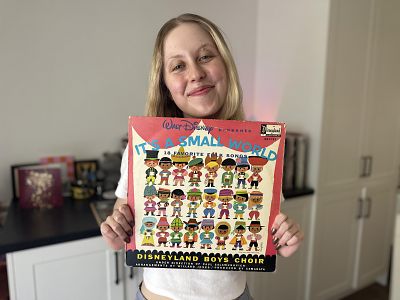
My partner (director Isaac Haigh) and I went to this suburban garage sale down the road in Cranbourne North, and I was immediately like… this is it. There were so many strange little objects, knickknacks, things with stories behind them. We found this vinyl record of a choir, and I just kept thinking ‘Where did this come from?’ ‘Who owned it?’ ‘How did it end up here?’
What can audiences expect?
It starts as a pretty normal suburban garage sale in Narre Warren… and then it gets weird.
There are lots of characters, lots of twists, and it moves into some unexpected, slightly supernatural territory. It’s playful, but there’s also a real thread of sentimentality running through it.
You describe yourself as introverted. How does that work in such an extroverted profession?
Yeah, I’m very introverted. I love people, but I need a lot of time alone to recharge.
As a kid, I would just sit and watch people: how they moved, how they talked, how they interacted. That’s kind of how I learned.
So even though performing is very outward-facing, everything I do really comes from that quiet, observational place.
You’ve also spoken about having ADHD and being sensitive to rejection. How has that shaped your career?
I have ADHD, and there’s a part of that, rejection sensitive dysphoria (RSD), that makes rejection hit a lot harder.
And this industry is full of rejection. You get really close to things sometimes, close enough to taste it, and then you don’t get it.
But honestly, I don’t think I would have made this show without that. A big part of it was wanting to prove to myself that I can do this.
Did creating your own show give you more freedom than auditions?
Definitely.
In auditions, you’re often trying to figure out what version of you they want: are you the “pretty one” or the “funny one”? It’s rare that you get to be both.
With my own show, I can just be everything. I can play all these different characters and explore all these different sides of myself. That’s been really freeing.
You play multiple characters. How do you build them?
I usually start with the voice, because I come from a singing background.
Once I find the voice, the physicality kind of follows. And a lot of it comes from observation, things I’ve noticed about people over the years.
I spent so much time as a kid just watching people, and I think that really stuck with me.
There’s a strong theme of objects and memory in the show. Why is that important?
I’m a very sentimental person. I still wear clothes I bought when I was 14.
So it made sense that the show would centre around objects and what they mean to people. Most of the props are second-hand, things I’ve found at garage sales or on Marketplace.
It felt important that everything had a history.
The show also touches on letting go. Was that intentional?
Yeah, definitely.
There’s this tension between wanting to move forward and not wanting to let go of the past. The show kind of sits in that space.
It’s about people downsizing, moving on… but also holding onto things that matter to them.
You’ve performed the show a few times now. How has the response been?
It’s been really lovely.
The first time I did it was in a pretty chaotic venue, we had 15-minute turnarounds between shows—but even then, people responded really well.
And then when I got to do it in the right space, it just clicked. It made such a difference.
What have you learnt about yourself through this process?
That I can do more than I thought I could.
A few years ago, I would have said there’s no way I’d do a solo show—it sounded terrifying. But things change as you grow as a performer.
I still don’t know what I’ll be doing in 10 years… but I think that’s kind of exciting.
What’s next for you?
I don’t think I’ll do another solo show straight away. It’s a lot.
But I’ve got a lot of ideas, especially with my partner. We’re working on some collaborative projects: maybe a duo show, maybe some online content.
It’s just about figuring out what feels right to focus on next.
Why should people come see the show?
If you like character-driven comedy with a bit of heart, and a bit of weirdness, you’ll probably enjoy it.
It starts off feeling very familiar… and then takes you somewhere unexpected.
Interviewed by Mary Sinanidsis