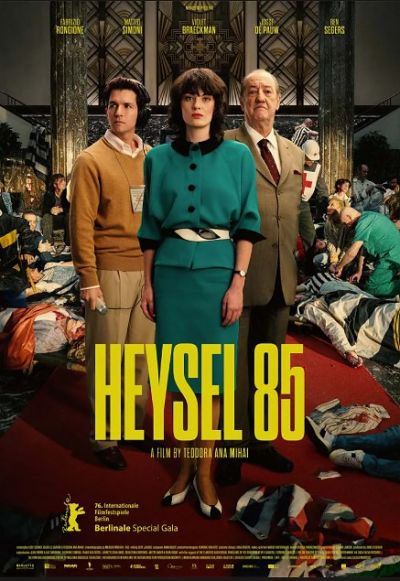
Heysel 85 | Sydney Film Festival 2026
Click here if you liked this article 27 
https://www.sff.org.au/program/event/heysel-85/
Date Reviewed: 02/06/2026
The Heysel Stadium disaster occurred on what should’ve been a great day for Brussels, with two of the world’s biggest soccer teams playing out a European Cup final on neutral turf. But it was a dark day for the sport, as sections of the stadium crumbled beneath a near-riot in the stands, causing 39 fatalities and hundreds of injuries.
Heysel 85 is a drama that splices real footage of the event with a fictitious take on what was being discussed and debated by the people in charge behind the scenes. The use of actual footage adds to the realism of the film and hooks you into believing that the characters being followed throughout its running time, are based on real characters. I must admit, I googled one or two names to see if some of the more controversial characters were based on real people!
What causes the tragedy? Once it occurs, the various characters start playing The Blame Game unlike anything seen since the break-up of The Beatles. But in this analogy, the Liverpool fans are Yoko Ono. While everything from fans without tickets sneaking in, to the make-up of fans in the neutral area, to the crumbling state of the stadium’s structure contributed to what happened; Heysel 85 largely points the finger at the Liverpool fans being the main cause, as they become aggressive, break through barricades, and attack Juventus fans.
This occurs within the first 30 minutes of the film. And while there are some dramatic plot points such as emergency medical attention for wounded fans, the breakdown of a family, and the search for family members (before mobile phones were everywhere); much of the next hour is spent debating whether the final should go ahead. There are passionate debates with a lot of finger-pointing and justification of a decision either way, with most characters being influenced by what would benefit themselves or absolve them of guilt.
In Heysel 85’s first act we are introduced to some of the key characters. Luca Rossi (Matteo Simoni) is an Italian reporter covering the final and the overall event. He has organized for his father, uncle, and younger brother to attend the game, and therefore, is personally invested in the safety of the patrons, while still trying to cover the story, once the horrific event starts to unfold.
Albert Simons (Fabrizio Rongione) plays the part of the police chief, who needs to make big-picture decisions based on the welfare of the wider town, even though he’s not actually on duty at the time of the tragedy.
Marc Dumont (Josse De Pauw) as the mayor who wants to celebrate the event being held in his town. But when things go wrong, he goes into self-preservation mode, looking for others to apportion blame to, and not committing to decisions that are time-critical, for fear it may damage his political position.
But the lynch pin of the whole thing is Marie Dumont (Violet Braeckman). Dumont is the daughter of the mayor, and his press attaché. She also speaks 4 languages and can perform duties as an interpreter. Based on her role and abilities, Marie becomes crucial to pass on information to the different parties affected by the tragedy and is constantly putting out spot-fires as she navigates the corridors of the stadium’s bowels. As she moves between the mayor (who has drunk himself into an ordinary state) and the various decision-makers that she must translate for, Marie also becomes the film’s moral compass that the viewer is supposed to relate to. Along with Luca, Marie seems to be the only main character who acts completely selflessly throughout the film.
With so much of the film being passionate debate between emotional characters, the acting is an absolute priority over all else. And in this sense the movie works, with stand-out performances from both De Pauw and Braeckman. But while all the main performances are impressive, the issue is that they’re justifiably debating an important topic, which many the film’s viewers will already know the outcome of. And in this sense the tension of the overall film would’ve increased, by shortening the time spent coming to the decision, and focusing more on the impact of the decision on characters in and around the stadium.
Director Teodora Ana Mihai does an admirable placing the viewer in the middle of the film’s verbal confrontation. Giving enough airtime to people arguing on both sides of the debate, and doesn’t appear to have an agenda to make those arguing on one side or the other, the villains of the piece. Instead, people on both sides are flawed characters, and arguments both ways are justified, allowing the viewer to make their own minds up.
It would be interesting to see what could’ve been done with a bigger budget – a focus on the fans within the sections of the stadium where the violence started, an expanded view of the oft-mentioned dilapidated stadium, or a re-creation of the disaster itself. Any of these elements would change the structure of the film, increase the action, and most likely ramp up the tension. Overall, it’s an effective film, that will be more-gripping for those that don’t know the film’s outcome already.
Reviewed by Dion Gaunt