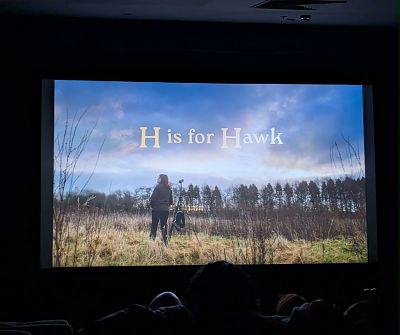
H is for Hawk
Click here if you liked this article 5 
https://www.cinemanova.com.au/films/h-is-for-hawk
Date Reviewed: 08/06/2026
In an era saturated by digital gimmicks, Philippa Lowthorpe’s H is for Hawk arrives as a masterclass in cinematic restraint. Based on the 2014 bestselling memoir by Helen Macdonald, this film strips away the superfluous to deliver a feature that relies on the power of exceptional performances and emotional honesty.
At its core, H Is for Hawk is a study of mourning, tracking the emotional derailment of Helen (played with intensity by Claire Foy of The Crown fame) following the sudden death of her beloved photojournalist father, Alisdair (Brendan Gleeson). Foy’s performance is stoic on the surface, yet masks a jittery, free-falling vulnerability underneath. Alongside her, Gleeson infuses the flashback sequences with such warmth and mischief that the audience is made to actively share the ache of his absence.
The film’s pacing employs a slow-moving aesthetic that beautifully mirrors the paralysing stillness of depression. Divided into a distinct "before death" and "after death" reality, the film's atmospheric shift heavily echoes the cinematic language of the recent box-office success Hamnet (also based on a bestseller). It captures the dislocating fog where the world continues in full colour while the bereaved move through it entirely off-centre.
Realism of the hunt
What elevates this narrative from a traditional "animal therapy" drama is its breathtaking, documentary-style filming of the goshawk, Mabel. Rather than treating the bird as a cinematic pet, the film weaves the fascinatingly details of falconry directly into the plot. We see the intense focus required to prevent the bird from bating, down to the bloody logistics of presenting fistfuls of raw meat while strictly avoiding eye contact.
The brilliant wildlife cinematography by Mark Payne-Gill capture soaring, stunning shots of Mabel in flight. The visceral sequences of her on the hunt provide a brutal yet beautiful depiction of the natural order.
This serves as a perfect parallel to Helen's personal journey, exquisitely conveyed during her lecture scene. When challenged by a student who asks, "Couldn't you feed her bird seed?" Helen responds directly with the uncompromising reality of the creature's anatomy: "Ah, no. No, she's a carnivore. Can you see her talons? You see that hooked beak for rending flesh... These tiny, tiny little feathers, they're like whiskers. They've evolved to hold the blood until it dries and flakes away. I mean, that's what they're for."
When the room questions the inherent cruelty of the hunt, Helen lays bare the philosophy connecting her own grief to the hawk.
"Death's already there. Death is everywhere, but we're just... we're constantly protecting ourselves from it... Hunting with Mabel, it's... it's an honest encounter with death. I'm sorry... So sorry that the rabbit's got to die. And Mabel's got to die. I've got to die, so do you. I mean... we're all going to die."
An Aussie anchor
While the original memoir is heavily interior, Emma Donoghue’s screenplay smartly introduces a vital social anchor in the character of Christina, Helen’s best friend. Christina is reimagined as an Australian academic, played by Denise Gough. She acts as a level-headed, non-judgmental anchor as Helen completely withdraws from society into her self-destructive obsession.
Gough captures the Aussie idiosyncrasy with authenticity. She provides a warm, calming presence mixed with dry humour that cuts straight through the film's bleakness. Her character beautifully captures that distinct, no-nonsense warmth we often take for granted in our closest mates here in Australia.
A standout moment of this unforced dynamic occurs during the shadowy exchange when they acquire the goshawk out of a car boot. Christina perfectly diffuses the high-stakes panic by deadpanning that the whole transaction "feels like a drug deal." It is a beautifully real depiction of the kind of friend who simply stays constant, holding space for you until your feet can touch the ground again.
H Is for Hawk is an honest look at a grieving mind skipping between obsession and isolation. It is quiet, emotionally demanding, and brilliantly allergic to the tidy resolutions and emotional manipulation that weaken so many films about grief. Backed by Charlotte Bruus Christensen's gorgeous cinematography and a haunting, understated score, this is a cinematic meditation on mourning that viewers will remember for a long time.
It is a privilege to watch a piece of cinema that lets silence and raw human emotion do the heavy lifting.
Highlights
- Powerful performances all-round, with Claire Foy delivering a fiercely committed, career-best performance.
- Extraordinary, documentary-grade footage of the goshawk in flight and on the hunt, a foil for Hollywood artificiality.
- Denise Gough's scenes offer a refreshing, deeply authentic dose of rough Australian humour and unconditional mateship that we take for granted in this country.
- A measured, slow-burning cinematic landscape that uses silence and stillness to echo the interior world of depression.
- Cinema Nova on Lygon Street, Carlton, where we watched the film, aware of the venue's deep roots in Melbourne's film community. Our screening in Cinema 13 offered an intimate viewing surrounded by great design and comfortable velvet lounge seating.
Who's it for
- Cinephiles and anyone seeking intelligent, counter-cultural narratives
- Nature and wildlife enthusiasts
- Viewers navigating grief.
Tip: During the scene with the psychologist, answer the questions as Helen answers and see where you are at on the depression scale. If you are in crisis, call Lifeline Australia on 13 11 14, available 24/5 for anyone facing emotional distress across Australia.
This review is dedicated to my late father Con Sinanidis on the 10th anniversary of his passing on 12 April 2016, in honour of his own dedication to photography, much like the character's own father.
Reviewed by Mary Sinanidis