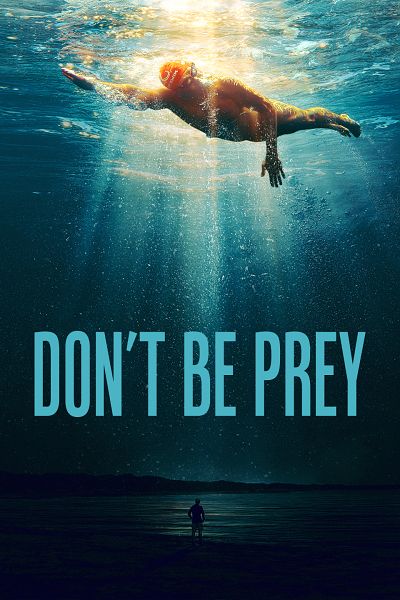
Don't Be Prey
Click here if you liked this article 1 
https://www.kismetmovies.com/releases/dont-be-prey
Date Reviewed: 29/04/2026
Long-distance swimming is often framed as a test of fitness and grit. In a pool, that sounds about right. But out in the open sea, it’s a completely different kettle of fish. As mentioned in the film, “you’re putting yourself in the food bowl.” You’re dealing with currents, cold, creatures, and your own physical and mental limits.
Mark Sowerby comes into this story having already experienced what it’s like to sink in a shark-infested environment, following the very public financial collapse of Blue Sky Alternative Investments. His business and reputation fell apart, and with that, he slipped into a deep, dark despair. The film handles this with care, not glossing over the fact that he had thoughts of simply swimming out to sea and never returning.
We begin by unpacking how the Blue Sky episode shattered his confidence and sense of self. From there, it becomes a story of overcoming trauma, confronting the weight of failure, and rebuilding. For Mark, that meant setting a new challenge. Several years earlier, he had conquered the English Channel and raised over a million dollars for charity. His coach from that time, Tim Denyer, perceptively reached out and suggested he take on the remaining six swims of the Oceans Seven — offering a renewed sense of purpose and direction.
Despite the name, it’s not about crossing seven oceans — the Southern Ocean would sort you out pretty quickly. Instead, it’s seven notoriously difficult channels around the world:
- The Molokaʻi (Kaiwi) Channel in Hawaii
- The English Channel between England and France
- The Catalina Channel off California
- The Strait of Gibraltar
- The North Channel between Ireland and Scotland
- The Cook Strait here in New Zealand
- The Tsugaru Strait in Japan
The list alone is enough to make you shiver. The North Channel is rough enough to challenge ferries. Molokaʻi has tiger sharks. The Cook Strait, which I’ve crossed many times by ferry, is known for its cold, wild conditions — and the occasional great white. Having experienced it, I have no desire to swim it. That said, I was quietly proud to see a school of dolphins representing New Zealand so beautifully on screen.
While the film captures the sheer beauty of these vast stretches of water, it doesn’t sugar-coat things: the cold that seeps into your bones, the exhaustion, the stings, the vomiting. But there’s also a quieter truth running beneath it all — these experiences change people, and bind them together in ways only a very exclusive group can truly understand.
We meet several key figures along the way, including his determined coach Tim and his patient, supportive wife. Tim, in particular, stands out — steady, intense, deeply understanding, but not one to indulge self-pity. He shows up, fully, for his swimmers.
Steven Munatones, whose simple idea of the Oceans Seven began as a blog, also features. What started small has grown into a global challenge, and the film captures just how far that ripple has spread.
We’re also introduced to the wider swimming community. Mark describes them as “ordinary people doing extraordinary things,” though they feel anything but ordinary. There’s a quiet strength among them, a mutual respect, and a generosity of spirit that feels rare and genuinely special.
Heidi, Mark’s wife, is another standout — not flashy or overplayed, just stoic, enduring, and real. Her commitment alone is commendable. In many ways, it seems harder to stand on the sidelines with no control than to be the one in the water. It’s clear he couldn’t have done it without her, or the support of his children. Though we don’t meet them directly, their words of pride and encouragement seem to restore much of Mark’s lost self-worth.
It’s impossible to ignore the sheer perseverance involved. The isolation alone could undo you. Even with a support crew nearby, it’s not always reassuring — at times, the swimmer disappears completely between the swells. Portions of these swims take place at night, which must be incredibly disorienting, lit only by red light to avoid attracting predators.
Mark struggles early on with negative thought spirals — something many people will recognise. But it’s the sense of community among these swimmers that helps carry him through. We see him reach land at the end of each channel, where it’s not the physical touch but the rapturous joy of his team that defines success for him.
The film is at its strongest in showing what might be called controlled hardship — the idea that deliberately putting yourself through something incredibly tough can, in a strange way, help heal deeper wounds. It’s not about chasing pain, but about discovering that you can survive it.
The film’s subtitle, One Day to Change Your Life, works both ways. Life can unravel in a single day — but it can also be rebuilt, step by step, stroke by stroke, until one day you realise you’ve found your way.
Reviewed by Vivien Lynch