Corporare - Evan Task in Outer Space
Click here if you liked this article 6 
https://www.theatreworks.org.au/2026/corporare-evan-task-in-outer-space
Date Reviewed: 18/06/2026
Corporare derives from the Latin corporare: to form into a body, to make material, to embody. It is both a word and a proposition, an apt title for a work concerned with what happens when ideology takes physical form, and progress ignores the people it hurts.
Part satire, part science fiction, and part philosophical inquiry, the play begins in the realm of corporate mysticism. The language sounds inflated and the movement appears fragmented, but everything gradually snaps into focus. We soon recognise the world being dissected: billionaire space races, Martian colonisation, autonomous vehicles, and the growing pile of orbital debris circling Earth. There are unmistakable echoes of Elon Musk, Jeff Bezos, and the seductive Silicon Valley promise that humanity can simply engineer its way out of the crises it created.
The myth and the martyr
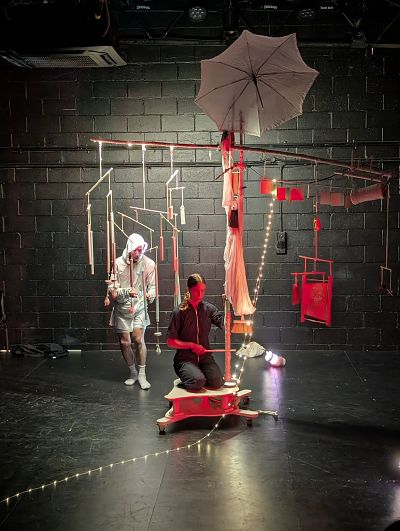
At the centre is Evan Tusk, performed by playwright Matthew Crosby. The name alone signals the target. Tusk is the modern tech visionary elevated to near-mythic status: part entrepreneur, part prophet, part brand. A skeletal white structure, resembling a fragile, lopsided clothesline, dominates the stage, serving as spacecraft, laboratory, and a monument to ambition all at once.
Around it move two figures. Tusk, dressed in white, is counterbalanced by Jojo, dressed in black. Played by director Tessa Marie Luminati, Jojo serves as both foil and conscience. Crosby, who founded Melbourne's experimental theatre collective The Thursday Group and teaches corporate accountability, writes from a place of lived engagement with these concepts. His performance captures the awkward charisma, certainty, and emotional fragility of a man who mistakes vision for wisdom.
“We seek an extra-planetary humanity born through joyous protocols of collective purpose.”
The language is intentionally inflated, equal parts corporate jargon and self-mythology. It is funny because it is familiar. Yet Corporare refuses to remain a mere parody; it pivots into an uncomfortable question: who bears the cost of progress when visionaries stop seeing the people beneath them?
That question arrives through Jojo, a former employee whose daughter died in one of Tusk’s autonomous vehicles. Luminati delivers the production's most affecting moments, cutting through Tusk’s high-minded abstractions with plain, devastating language. In one striking image, she scatters illuminated lanterns across the stage like fragments of a shattered body.
Tusk responds with chilling familiarity: “Your loss has been settled handsomely.” Human suffering becomes liability; accountability becomes settlement.
Jojo lashes back: “Do you feel me reaching through the skin of your impunity? I grasp the dense muscle of your heart and squeeze.”
In that moment, rhetoric collides with lived experience.
A physical and intellectual battlegrouned
Throughout the production, language itself is a battleground. The recurring motif of transducers (devices that convert light into electrical signals) evolves into a meditation on perception. Reality is filtered and manipulated. As failures accumulate, Tusk continues overriding warnings to protect his narrative. “The protocol remains unchanged,” he insists, as instruction hardens into ideology.
The same applies to the "Blue Sky Protocol." The audience is encouraged to repeat the mantra: “Blue Sky. Blue Sky. Beautiful blue sky together.” What begins as optimism slowly curdles into conditioning, making the audience complicit through participation.
Yet Corporare is as much a physical work as an intellectual one. Crosby's embodiment is remarkable; at times he vibrates with contained energy, while at others he lowers himself to the floor, moving with primate-like precision that suggests a regression beneath the polished veneer of innovation.
The lighting design reinforces this instability, carving fractured shapes through haze and shadow. In the final moments, Evan appears to shrink as his shadow expands monstrously behind him, a brilliant image of the cult of personality overtaking the person. We have seen it before in Musk, Bezos, Elizabeth Holmes, and Sam Bankman-Fried, individuals whose public mythologies eventually outgrew reality.
The verdict
The inevitable climax arrives when Tusk declares: “I want to write the protocol. I want you to follow it.” Here, the language of disruption falls away to reveal something much simpler: control.
Corporare is ambitious, inventive, and intellectually rigorous. The shifts between satire, grief, absurdity, and philosophy are handled with impressive confidence. It offers no easy answers. Instead, in an age increasingly shaped by powerful men selling futures the rest of us must inhabit, Corporare feels less like science fiction than a stark, beautifully executed warning.
Highlights
- Strong, precise physical and emotional delivery from both actors.
- Set and lighting designs that beautifully visualise psychological fracture.
- An intelligent, well-paced script that hits you in waves and leaves plenty to dissect.
- A production that will have you reaching for a dictionary afterward.
- The incredible shock you feel when you realise exactly what the play is about.
Who it’s for
People who like to think. Audiences drawn to physical theatre, contemporary political satire, and thought-provoking work that prioritises philosophical depth over straightforward narrative clarity. Highly recommended for artists, activists, economists, and tech professionals, owners of Tesla cars and Elon Musk.
The Explosives Factory is at 2/67 Inkerman Street, St Kilda. Runs through to the 27 June, 7.30pm (except Sunday and Monday)
Reviewed by Mary Sinanidis