BLAK N BLUES
Click here if you liked this article 5 
https://www.theatreworks.org.au/2026/blak-n-blues
Date Reviewed: 14/02/2026
You don’t expect the blues at a stage venue like Theatre Works. You expect black box angst, a tight monologue, something curated. The blues belongs in a basement late-night bar: low ceiling, cigarette smoke swirling (if smokers still exist), whiskey glasses sweating on sticky tables. misery and melancholy, heartbreak leaning against the jukebox.
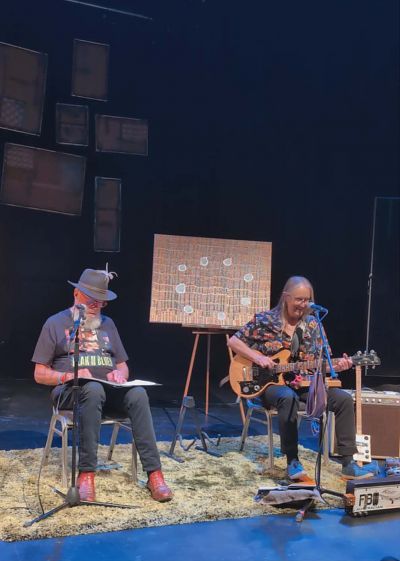
Instead, Blak n Blues unfolds on stage and we watch as the blues take on a new form, a yarning circle with guitars. It’s a conversation that at times leans closer to a lecture with music than a traditional performance, but that’s also its point. You’re not just entertained; you’re asked to listen, learn, and witness the collision of two distinct but echoing oral traditions - First Nations tales and the Mississippi Delta.
The collaboration pairs Uncle Glenn Loughrey — proud Wiradjuri man, Anglican priest, artist, poet and long-time advocate for indigenous rights — with Fiona Boyes, Australia’s most internationally recognised female blues guitarist.
The Fiona factor
Boyes is no pub amateur. She got her teeth in Melbourne’s suburban cafés before founding the all-female blues outfit The Mojos in the 1980s. While her teenage peers were into pop, she was obsessing over pre-war barrelhouse blues and double-entendre queens like Memphis Minnie, Ida Cox and Victoria Spivey.
She went on to win the acoustic solo/duo division at the International Blues Challenge in Memphis, the only Australian ever to take that prize. Multiple nominations from the Blues Foundation in the United States, playing Beale Street, recording in Austin, touring relentlessly… that’s how she built her reputation as one of the country’s finest finger-picking stylists.
During this midday performance, her playing is steady, warm-toned, deeply literate in tradition. Not flashy. Not showy. Competent, grounded, occasionally soaring. You feel decades of immersion in the genre. She moves easily from classic Delta textures to cheeky, suggestive numbers about “old stiff preachers” (too much information about her husband included), and even offers an audacious answer song to Leonard Cohen, a benediction of optimism in response to his late-career darkness.
She understands that blues is both muscle and mischief and plays it on improvised, rootsy instruments collected during her travels: a battered cigar-box guitar, a stripped-back three-stringer, and slide work that keeps the sound raw rather than polished. Tradition, but with grit still under the fingernails.
Enter Uncle Glenn, the poet pastor
Uncle Glenn brings something else entirely.
He has spent the past few years travelling the country as an advocate for Indigenous. He also briefly made headlines for a frustrated Facebook rant. The post was deleted the same day; he issued an unreserved apology, acknowledging it did not advance reconciliation. The dioceses publicly affirmed their support for his ongoing work.
That context matters. On stage, there is no ranting. No frothing anger. If anything, the tone is measured; reformed, reflective, restrained.
His poetry is simple but wise. Short lines. Clear language. Nothing ornate. He speaks of promises made and broken, of being “placeless”, of fences built in the name of order. A poem titled War is Murder reduces geopolitics to brutal truths: “children die, mothers cry”. It is political without being partisan.
One of the most striking ideas he shares is “everywhen”, the Indigenous understanding that time is not linear but circular. There is no straight line from A to B. In many Aboriginal languages, he explains, there was no word for “straight” before bulldozers carved them into the land. Past, present and future coexist. Ancestors are not gone; they are present. Sovereignty, then, is not a slogan but an embodied continuity.
“Body carries body. Country carries country.”
It’s a line that lingers longer than a guitar riff.
His acknowledgement of Country is understated. No theatrics. No moral grandstanding. You’re invited to think, not instructed what to think. Draw your own conclusions but keep an eraser handy.
The chemistry
Blues has always belonged to the outsider. Indigenous thought understands the outsider. That’s where the pairing works like a Valentine’s Day romance.
Boyes speaks of blues as a thread passed through generations, musicians learning from elders, shaping their own voice within a tradition. Loughrey mirrors that in Aboriginal cultural continuity. Different histories. Similar frameworks.
The audience was intergenerational: children, retirees, the odd couple on a Valentine’s Day date. Not full, but attentive. A “Sovereignty Was Never Ceded” T-shirt here, an Aboriginal flag there. A pastor’s wife on stage. A retired pastor beside her describing himself as “a pastor with a past.”
The tension between fringe music and theatre respectability felt fitting, even poetic, for a Valentine’s Day show about love, loss and belonging.
During interval, Uncle Glenn worked the foyer and outdoor courtyard. Handshakes. “Thanks for coming to my show.” He showed his artwork, explained symbolism. Very local. Very grounded.
Outside, festival energy drifted past from St Kilda Festival on the waterfront. Nina Taylor MP wandered by doing the rounds, Aboriginal flag badge pinned to her lapel. “What’s going on here?” she asked, peering in.
Inside, the answer was unfolding quietly: not a spectacle, not a protest, but a dialogue between blues and Blak, between faith and frustration, between history and now.
Highlights
- The pairing of blues and indigenous poetry works like a spiritual romance.
- The learnings, such as the concept of “everywhen” and circular time.
- Boyes’ finger-picking in the signifying blues numbers.
- The poetry on placelessness, stripped back and resonant.
- The Leonard Cohen answer song, unexpectedly hopeful.
- Joy breaking through the blues.
- Humour in the banter between Fiona and Uncle Glenn.
Who’s it for?
- Blues lovers who want context.
- Those interested in Indigenous culture beyond slogans.
- People wrestling with reconciliation but wary of being preached at.
It’s not the slickest show in town. It isn’t trying to be.
Sometimes the most honest nights feel slightly unfinished, like conversations that don’t resolve neatly.
And maybe that’s the point.
Reviewed by Mary Sinanidis