Beethoven’s Ghost
Click here if you liked this article 3 
https://musicaviva.com.au/concert-season/
Date Reviewed: 09/05/2026
I was very much looking forward to this performance, and Musica Viva did not disappoint with Beethoven’s Ghost at the Adelaide Town Hall.
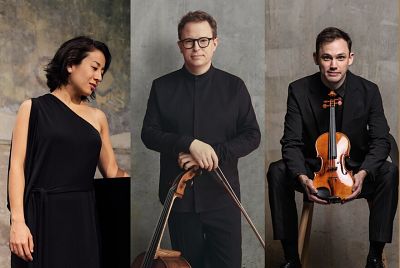
The trio featured pianist Aura Go, cellist Timo-Veikko Valve and violinist Kristian Winther. It was clear that the three artists had a strong history of performing together in various combinations; the ensemble dynamic felt instinctive, with each player complementing the others’ style effortlessly. Their individual expertise as soloists was evident in their seamless unity as a trio, resulting in a polished and cohesive performance.
The group also brought a touch of personality to the stage, with Aura Go’s green blouse offering a refreshing detour from the usual black concert attire, which traditionally keeps the viewer’s focus almost entirely on the music. The trio were animated and passionate, not only in their playing but also in their physical performance. This added a visually engaging element that complemented the beautiful music of the evening without becoming distracting or overdone.
What struck me most about the evening was the female representation. Not only was there a female pianist alongside male string players, but female composers were also featured in the program.
Melody Eötvös’ trio was an exciting work to hear. This world premiere of Regnare, commissioned for Musica Viva, referred to Eucalyptus regnans, or the Mountain Ash tree, found in Victorian and Tasmanian landscapes. As the Mountain Ash is vulnerable to bushfires, the piece carried a palpable sense of danger and fire, with tension, dissonance and all three instruments exploring the lower registers. This stood in striking contrast to the following trio, albeit separated by interval, by French composer Lili Boulanger, who preceded Eötvös by a century. It was also remarkable to hear a work less than a year old by a living composer.
Personally, I found Boulanger’s trio the eeriest work of the night, despite the “Ghost” in question referring to the opening work, Beethoven’s Piano Trio in D major, and in particular its spooky, slow second movement. There has long been speculation as to whether this piece was intended for Shakespeare’s Macbeth, or Hamlet, as Beethoven’s student Czerny suggested, which gave the trio its “Ghost” name. With the mystery unresolved, it added further foreboding to this “Ghost” Trio.
This was an incredible conversation between the instruments, rather than two instruments simply supporting a lead. For this concept to succeed, it relied on the performers’ precise synchronisation and the clear sense of ensemble cohesion established throughout the evening.
The bookending of the concert by two musical giants, Beethoven and Ravel, contributed to a wonderfully balanced program. Ravel’s Basque-flavoured 1914 Piano Trio was an inspired choice to close the performance, and the opening movement was, by far, a personal standout. The colouring was bright and airy, while the fourth and final movement delivered a vibrant burst of energy. My eyes were particularly drawn to the full use of the piano keyboard’s range in this movement.
The interplay of instruments throughout this trio gave equal importance to each of the three musicians, a running feature of all the trios performed that evening. Despite the brilliance and vitality of Ravel’s Piano Trio, it was difficult to believe it had been written during World War I, a period that had a particularly distressing impact on the composer. Nonetheless, given the chance, I highly recommend hearing this Piano Trio live.
Reviewed by Juliet Morelli