'Bad Apples' — British Film Festival 2026
Click here if you liked this article 0 
https://britishfilmfestival.com.au
Date Reviewed: 24/10/2026
There is something deeply uncomfortable about laughing at a child’s suffering, even when that child happens to be the source of everyone else’s misery. Jonatan Etzler’s Bad Apples turns this discomfort into its central pleasure, cultivating a darkly comic world in which the boundaries between discipline and cruelty, sympathy and complicity, become increasingly difficult to distinguish. What begins as a familiar story of a primary school teacher struggling with a disruptive student gradually develops into something far more sinister: a moral experiment in which everyone seems willing to compromise their principles, provided the results are convenient.
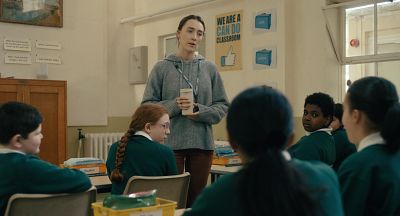
Maria (Saoirse Ronan) is a teacher nearing the limits of her patience. Her classroom is repeatedly disrupted by Danny (Eddie Waller), a volatile student whose aggression makes it difficult for the other children to learn. When one of the classmates is injured, Maria’s professional composure begins to unravel. A series of increasingly disastrous events culminates in Danny being locked in the basement of her home. What initially appears to be an impulsive mistake becomes a secret she is unwilling to surrender, particularly when his absence produces an unexpected result: her classroom begins to flourish.
The premise is outrageous, but Etzler treats it with a disquieting matter-of-factness. Danny’s muffled cries and pounding against the basement door provide an unsettling counterpoint to Maria’s attempts to maintain some semblance of normality. There is something almost unbearable about hearing a child plead to be released while the person responsible continues with her day. Maria’s guilt is palpable, but so is her reluctance to relinquish the quiet she has finally obtained. The film understands the terrible seduction of a problem that appears to have solved itself.
Ronan is exceptional as Maria, conveying an entire internal crisis through the smallest changes in expression. Her face becomes a study in contradiction: anxiety flickers into relief, guilt gives way to irritation, and moments of apparent tenderness are shadowed by an awareness of what she has done. Ronan has a particular gift for making a character’s thoughts visible without making them entirely legible. We can recognise Maria’s desperation without necessarily forgiving her actions, and it is this tension that gives the performance its force. She is neither an uncomplicated villain nor a sympathetic victim of circumstance. She is a woman who has crossed a line and is discovering how easily one transgression can become the justification for another.
The film’s dark humour emerges from precisely this discomfort. Maria begins to care for Danny in ways that resemble a grotesque imitation of parenting. She buys him clothes and attempts to teach him lessons, transforming her captive into a peculiar domestic responsibility. The absurdity is difficult to separate from the horror. Danny is still a child, regardless of how frightening his behaviour becomes, and the longer he remains confined, the more the situation exposes the inadequacy of Maria’s own moral reasoning. Her actions are not made less disturbing by the fact that she can rationalise them.
Pauline, a seemingly studious, teacher-pleasing classmate played by Nia Brown, introduces another unsettling dimension. When she discovers Danny’s whereabouts, the balance of power shifts once again. Rather than simply exposing Maria, Pauline recognises an opportunity to exploit her teacher’s secret. Brown is terrific in a role that makes the familiar figure of the well-behaved student unexpectedly menacing. Pauline’s apparent innocence becomes a kind of disguise, and her willingness to manipulate the situation is infuriating precisely because it is so casually presented. In this classroom, good behaviour is not necessarily evidence of goodness; sometimes, it is simply another means of getting what one wants.
The film’s school setting is particularly effective. The classrooms, corridors and familiar rhythms of primary school life evoke the peculiar social ecosystem of childhood, where authority is constantly tested and the smallest disruptions can consume an entire room. Anyone who remembers sitting in a classroom while a teacher struggled to regain control will recognise the atmosphere of mounting frustration. Yet Bad Apples takes this familiar dynamic and pushes it towards the grotesque. The students are not merely passive witnesses to adult authority; they observe, adapt and learn from it. As the situation escalates, the children’s involvement becomes increasingly troubling. Maria may be the adult, but she is hardly the only person making morally questionable decisions.
Visually, Etzler sustains the film’s uneasy balance between comedy and menace. The cinematography makes effective use of framing and carefully composed shots, while the music intensifies the growing sense that Maria’s predicament is slipping beyond her control. The film’s apple imagery is particularly suggestive. Early scenes introduce apple production and orchards, motifs that recur as the story develops. The familiar expression “a bad apple” becomes an increasingly unstable metaphor: is Danny the rotten fruit contaminating the classroom, or has Maria become the bad apple herself? Perhaps the film’s more unsettling suggestion is that rot rarely remains contained. It spreads through the structures surrounding it, particularly when everyone has an incentive to pretend nothing is wrong.
This is where Bad Apples becomes more than a dark comedy about a teacher and her most difficult student. As Maria’s secret becomes entangled with the lives of those around her, the film asks how far people will go to preserve an arrangement that benefits them. The classroom improves without Danny. The adults around Maria have reasons to avoid confronting what is happening. The apparent success of the situation becomes its own defence. The question is no longer simply whether Maria’s actions are wrong, but why their consequences seem to matter less when everyone else is doing better.
There are moments when the film’s increasingly outrageous developments stretch credibility, and its characters can seem to inhabit a world in which common sense has been temporarily suspended. Yet this heightened absurdity is also central to its appeal. Bad Apples is less interested in presenting a realistic account of a teacher’s breakdown than in constructing a scenario that forces its audience to examine its own sympathies. How much Danny’s behaviour frightens or frustrates us becomes part of the film’s moral machinery. We may understand Maria’s desperation, but at what point does understanding become complicity?
The ending refuses the comfort of a neat resolution. Danny’s escape leaves the consequences of Maria’s actions hanging in the air, with the film offering no definitive account of what awaits either of them. The uncertainty is fitting. By this stage, the damage extends beyond the basement, implicating a wider network of people who have allowed the situation to continue. One hopes that accountability will reach everyone involved, not just the person at the centre of the scandal.
As part of the 2026 British Film Festival, Bad Apples makes for a compelling choice, offering an entertaining but decidedly uncomfortable examination of authority, responsibility and the stories people tell themselves to justify their behaviour. The festival’s broader programme, spanning films old and new, promises plenty to explore, but Etzler’s film is a particularly memorable reminder of cinema’s ability to make us laugh at things we would rather not admit we find funny.
With a terrific central performance from Ronan, sharp visual motifs and a premise that grows more disturbing the longer it unfolds, Bad Apples is an entertaining exercise in moral unease. Its most rotten fruit may not be the child who disrupts the classroom, but the adults who discover that, under the right circumstances, wrongdoing can be made to look remarkably convenient.
Reviewed by Scarlet Lili Thomas