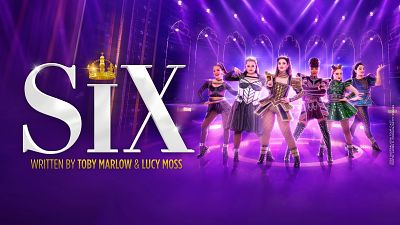
SIX The Musical: Losing Their Heads, Finding Their Voices
Click here if you liked this article 4 
Date Reviewed: 29/07/2026
Most people know Henry VIII as the king with six wives. Fewer could name those women, and fewer still could tell you much about them beyond the way each marriage ended. SIX The Musical begins with that imbalance and turns it on its head.
At first glance, SIX The Musical appears to be an exceptionally polished pop concert with Tudor references, spectacular costumes and six women determined to out-sing one another. Look a little closer, however, and something far more interesting is taking place. Beneath the sparkle is a sharp examination of the way women’s suffering is compared, packaged and turned into entertainment.
Reality television, social media and even everyday conversation frequently encourage women to measure themselves against one another: who has sacrificed more, suffered more, aged better, succeeded faster or survived the greatest hardship? SIX initially plays this contest for laughs before gradually revealing what is wrong with the question itself. Why should any of these women have to win recognition through pain? More importantly, why should Henry remain the person around whom their identities revolve?
This new Australian company understands that progression beautifully. The humour is fast, cheeky and precisely timed, but the performers never allow their queens to become caricatures. Each woman arrives with a carefully constructed public persona, and part of the pleasure lies in watching those personas begin to crack.
Sarah Murr establishes Catherine of Aragon as a commanding first queen. Her performance possesses tremendous vocal authority, but there is also dignity beneath the defiance. This Catherine has spent years being told that her marriage, loyalty and position can simply be erased. Murr gives her resistance substance; it feels less like stubbornness than a refusal to disappear.
Making her professional stage debut as Anne Boleyn, Mia Paris Scalise demonstrates terrific comic confidence. Her mischievous expressions and apparently casual delivery generate some of the evening’s biggest laughs. Yet she also allows us to glimpse the intelligence beneath Boleyn’s playful recklessness. The comedy works because Scalise knows exactly what her character is doing, even when Boleyn pretends otherwise.
Cara Bessey brings impressive emotional control to Jane Seymour. “Heart of Stone” remains the production’s first major tonal change, but Bessey does more than simply deliver the expected power ballad. Her restrained beginning gives the song somewhere to travel, allowing its emotional force to build naturally. The result is moving without becoming overly sentimental.
As Anna of Cleves, Kadesa Honeyhill bursts through the Tudor marriage market with glorious self-possession. Rejected by Henry after failing to resemble a flattering portrait, Cleves ultimately receives one of history’s more satisfying consolation prizes: independence, property and freedom from the king. Honeyhill embraces the comedy and physicality of the role while making Cleves’ confidence feel genuinely earned. She is not pretending not to care; she has discovered that Henry’s rejection may have been her liberation.
Angela Brischetto delivers the production's most confronting performance as Katherine Howard. As "All You Wanna Do" darkens from flirtation to exploitation, she trusts the material, allowing its accumulating unease to speak for itself.
Lorinda May Merrypor gives Catherine Parr an assured intelligence and grounded presence. Parr is the queen who finally challenges the terms of the contest, recognising that competing over Henry merely keeps him at the centre of their stories. Merrypor communicates that revelation with clarity and warmth. Her Parr does not simply end the argument; she offers the other women a way out of it.
What makes the cast especially satisfying is the absence of a weak link or an obvious hierarchy. Every performer possesses the vocal strength and individual presence to front the show, yet their greatest impact comes when they sing together. That becomes the musical’s cleverest answer to its own competition. The queens do not need to diminish one another to be seen.
Carrie-Anne Ingrouille’s choreography gives each queen an individual physical language while maintaining the precision of a genuine pop concert. Gabriella Slade’s costumes remain extraordinary creations: part Tudor armour, part contemporary stagewear and entirely distinctive. Rather than dressing the women as variations of the same pop star, the designs allow each personality to register before a word has been sung.
Emma Bailey’s set places the excellent onstage band, affectionately known as the Ladies in Waiting, within the action rather than concealing them. Musical Director Claire Healy leads a tight, powerful group whose live playing gives the production its pulse. Tim Deiling’s lighting transforms the relatively contained set with colour, silhouettes and sudden bursts of concert-scale intensity, while Paul Gatehouse’s sound design maintains the difficult balance between six formidable voices and a driving live band.
Created by Toby Marlow and Lucy Moss, SIX has now been performed around the world, circulated through countless online clips and absorbed into popular culture. Familiarity, however, has not dulled its effect. If anything, the musical has become more exciting because audiences arrive knowing the songs, the queens and the spirit of the show, ready to be part of its infectious energy from the opening number.
The show runs at a breathtaking pace, but its brevity is part of its strength. There is no interval, no unnecessary subplot and, significantly, no Henry VIII. His absence becomes one of the production’s most effective choices. He may have shaped the circumstances of these women’s lives, but he is denied the opportunity to occupy their stage.
By the finale, the queens have stopped asking the audience to decide who suffered most. They are no longer wives competing for space in a king’s biography, but six women imagining lives beyond the endings history assigned them.
The crown, it turns out, was never the prize. The victory is in refusing to compete for it.
SIX is playing at Melbourne’s Comedy Theatre until October 4 then at Theatre Royal Sydney from October 9 and at QPAC’s Playhouse Theatre in Brisbane from January 2027.
Reviewed by Irena Begelfor